Catholic Transcript: Summer 2025
Pope Leo XIV and the Challenge of Artificial Intelligence
Story by Joe Pisani
In the last class of the semester, one of my students gave an impassioned speech about the dangers of artificial intelligence. I wish Pope Leo XIV could have heard it, because two days later the newly elected pontiff offered his own sobering account of why we must be cautious of where AI is taking us.
“In our own day, the Church offers to everyone the treasury of her social teaching in response to another industrial revolution and to developments in the field of artificial intelligence that pose new challenges for the defense of human dignity, justice and labor,” Leo XIV, said in his first address to the College of Cardinals.
The challenges it presents are more insidious than those society confronted during the Industrial Revolution, when Pope Leo XIII wrote the encyclical “Rerum Novarum” about workers’ rights and capitalism.
Like most of us, my student was astonished at AI’s ability to solve his problems at his customer service job. He got an immediate response to a customer’s question about how many bags of cement would fit into a truck he rented.
It was a pedestrian question, but that simple encounter demonstrated the temptation AI has for us. We’re intoxicated by its potential, when we should be wary of its threat.
Enter Pope Leo, who has said AI will be a fundamental concern of his papacy.
Deep fakes in porn and politics, misinformation, intellectual property infringement, not to mention Mark Zuckerberg’s prophetic vision that in the future we’ll be blessed with AI friends to allay the loneliness.
Pope Francis also issued a warning about AI’s ability to “create partially or completely false narratives believed and broadcast as if they were true.” And in January, the Vatican published a document about the limitations of AI and the ethical issues surrounding its development and use.
Artificial intelligence reminds me of that famous “Twilight Zone” episode about the benevolent 9-foot-tall aliens called Kanamits, who came to Earth to solve all our problems, bring peace, prosperity and technological progress with the goal “To Serve Man,” which was the title of their manifesto. Humanity would eat, drink and be merry … until someone translated “To Serve Man” and discovered it was actually a cook book.
I have friends who are taking a “let’s wait and see” attitude, and find ChatGPT useful in drafting letters of recommendation and other documents, even though someday that helpful program will probably have their jobs.
Writers are already in the crosshairs, with an estimated 30 percent of jobs disappearing, and some media companies are using AI to produce stories about real estate and sports. Non-profits are even relying on AI to create press releases.
When it comes to being expendable, journalists are at the top of the list, along with software engineers, cashiers, factory workers and many others.
AI has also led to rampant cheating in colleges and high schools. Last year, I asked a class to critique a TED Talk by a famous defense attorney, and I was surprised and proud when I read their submissions.
“These are pretty good,” I thought, “I’m getting through to them.”
But the joke was on me. After reading a few assignments, I began to detect the same phrases, the same adjectives, the same observations and it occurred to me that ChatGPT was the actual author.
Now, when I give them writing assignments, I utter the same plea: “I want your original work. I prefer your flawed human intelligence to artificial intelligence. Don’t go over to the dark side.” It’s often to no avail because the temptation is too great, and the deception is too easy to pull off. For a time, I was running the work through an AI detector, but it added hours to the grading process.
Another professor I know at a respected Jesuit University is so distraught that he requires his students to do their writing assignments in class. It’s a less-than-perfect solution because it takes away from time that could be spent more productively in discussion and debate.
In another class, I asked the students about their career aspirations and got responses that included finance, health care, design, journalism and education.
I sighed and gave them the bad news, which probably never occurred to them. This toy they love tinkering with will probably be responsible for their jobs disappearing. Who’s going to need a graphic designer in five years?
In articulating his vision, Pope Leo XIV rightly identified artificial intelligence as one of the most critical issues of our time, a technological development that could threaten the future of humanity while it promises to save it. Sounds like the Kanamits to me.
Parish Bulletins Remain Relevant in the Digital Age
Story by Shelley Wolf
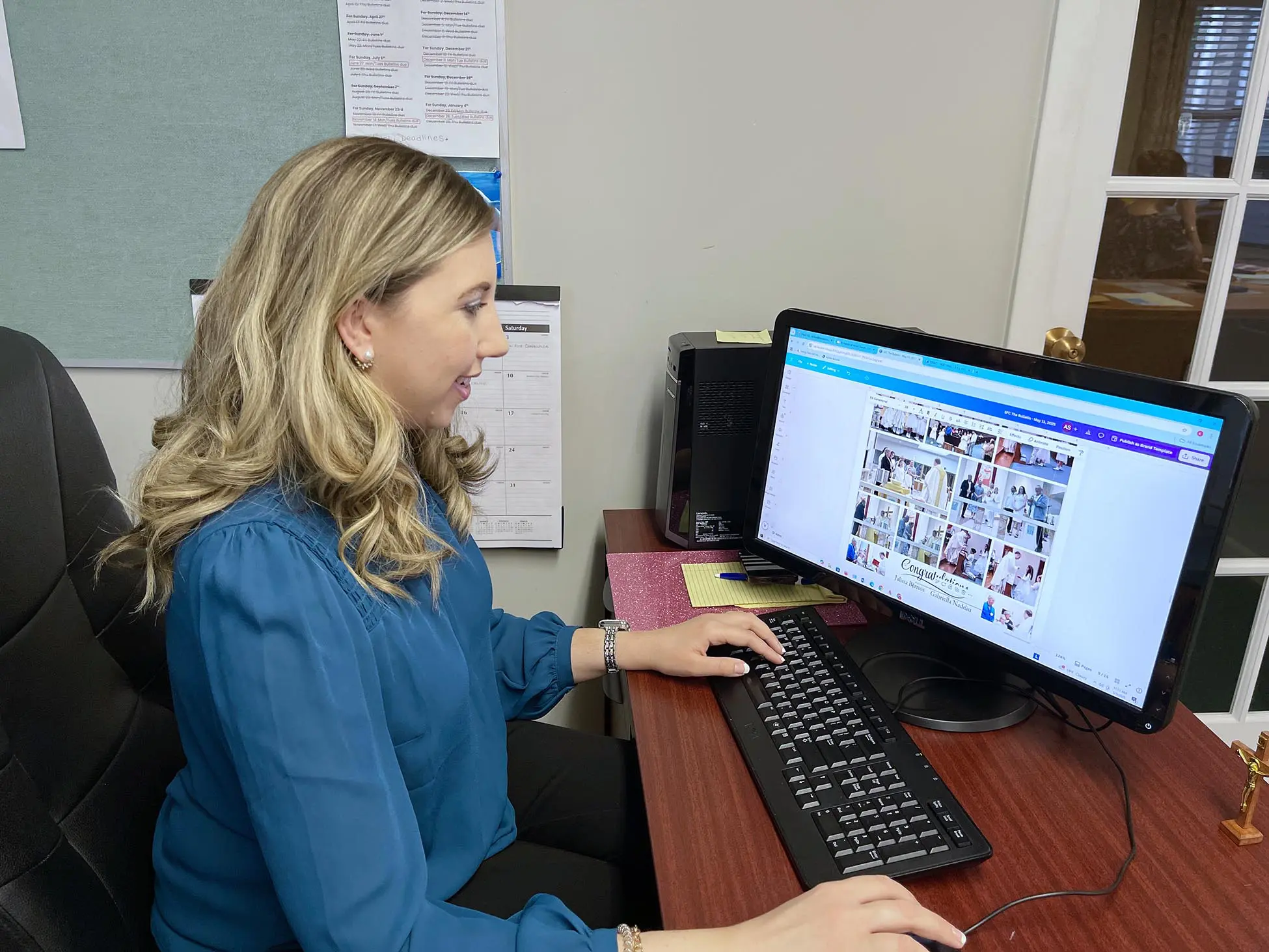
Parishes within the archdiocese are always looking for better ways to engage parishioners. To meet parishioners’ information needs and grab their attention, two parishes recently overhauled their Sunday bulletins with fresh new designs, more graphics and photos, and enhanced content.
Blessed Michael McGivney Parish, which serves all Catholics in New Haven, unveiled its newly redesigned 20-page, four-color bulletin, printed by LPi, during Lent.
The front page includes a large parish logo with the letters “NH” and a golden cross. The interior, which sports colorful graphics and new fonts throughout, also provides information in three languages – English, Polish and Spanish – to reflect the languages spoken in its communities.
“New Haven is also unique in that we have many visitors from week to week, and many new parishioners who are moving to the city. And providing them with information in the bulletin is the fastest and easiest way to reach them,” the parish wrote in its bulletin survey results, published earlier this year.
Before rethinking the bulletin, the New Haven parish conducted a print and online survey to gauge its readers’ wants and needs. Survey respondents said the bulletin was “even more important” as a resource for parish information than the parish website, emails and social media.
Survey results also showed that 58% of respondents read only the printed version, 33% read both the printed and digital versions, and 10% read only the online version.
The top five types of information parishioners wanted included a weekly calendar of events, a list of ministries and descriptions, adult faith formation content, a list of staff and contact info, and a “get to know each other” section.
Now the newly redesigned bulletin opens with a list of clergy members and the names and addresses of its eight churches, followed by pages with contact information and Mass times.
To more broadly publicize activities, subsequent pages combine information from all of its worship sites, neatly organizing items under the subheadings of “Parish News & Upcoming Events,” “Parish Ministries,” “Parish Outreach,” “Parish Prayer, Study & Devotion,” “Faith Formation” and “Other Events.”
Likewise, St. Francis Parish in New Britain revamped its Sunday bulletin starting in January, taking an even more visual approach. The parish switched to publishing a longer 16-page, four-color bulletin every two weeks. The publication is now more photo-driven and is printed on glossy paper by LPi.
Each issue opens with a full-page of religious art or a local photo on the cover and the St. Francis Catholic logo, a white crucifix in a blue circle. The second page includes a table of contents for easy use, Mass schedule, church locations and mission statement.
In the later pages, parish leaders are identified with photos and contact information. The parish office location is demystified under a large heading, “Where to find our parish office.”
Also included are a reflection, upcoming parish events designed like ads, fun photos of past parish activities, QR codes that take readers to videos on the website, a table of ongoing ministry meetings, a checklist of items needed for the parish pantry, and puzzles for children.
The parish produced its first “A Year in Pictures” in January too, illustrating the major activities of the past year in a colorful, month-by-month photo layout.
To view the latest bulletin at Blessed Michael McGivney Parish, visit newhavencatholic.org/weekly-bulletin. To see the latest bulletin at St. Francis Parish, visit stfranciscatholic.org/bulletin.html.
A New Guild
The Monastery of Our Lady of Grace establishes the Aquinas Guild.
Story by Karen A. Avitabile
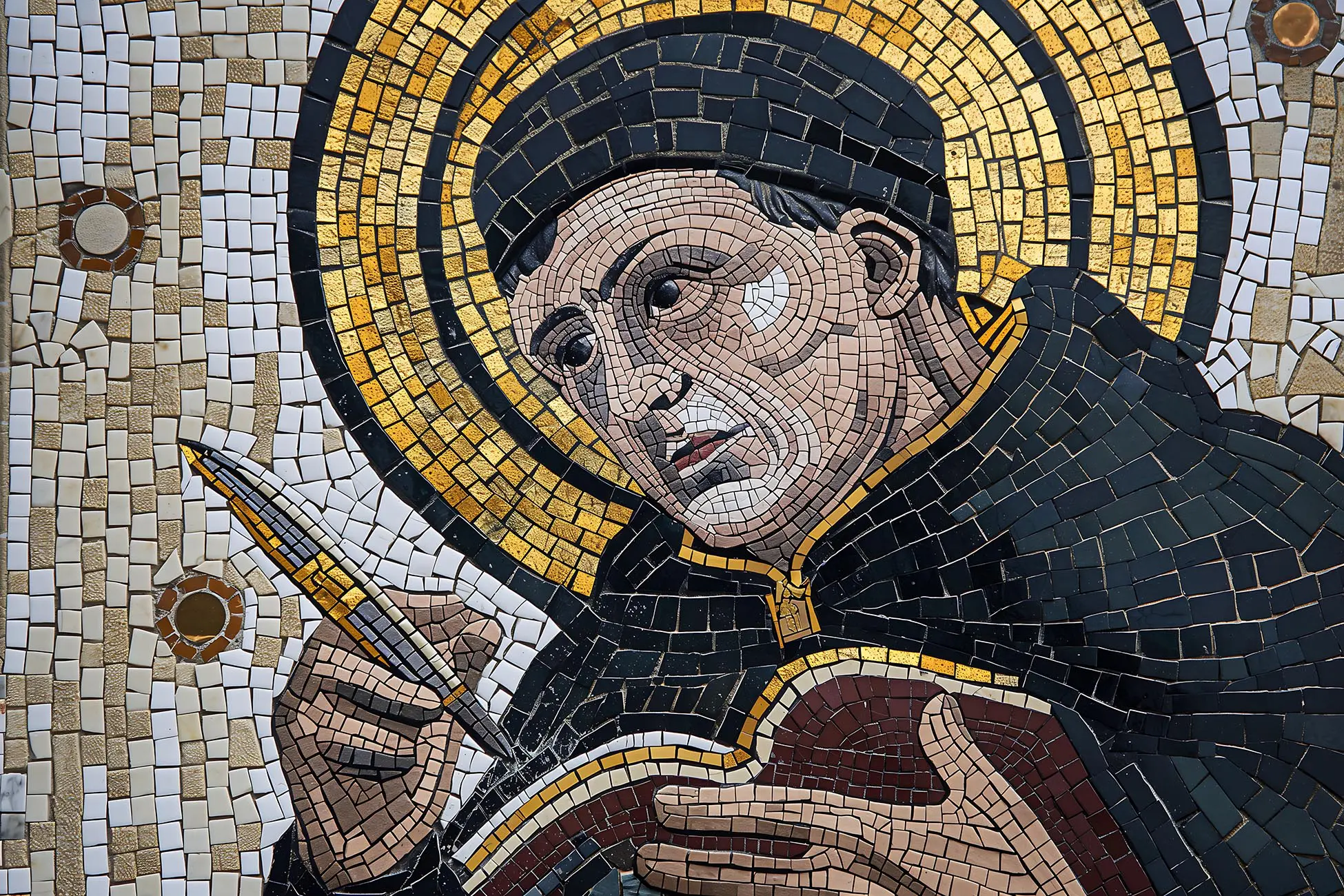
Earlier this year, on the feast day of St. Thomas Aquinas, and at the close of the triple jubilee marking his canonization, birth and death, the Monastery of Our Lady of Grace, a Dominican community of cloistered contemplative nuns, established the Aquinas Guild with St. Thomas as its patron.
“St. Thomas is our brother in the Dominican Order,” says Sister Maria of the Angels, O.P., prioress of the Monastery in North Guilford. The nuns follow the Rule of St. Augustine but that is given further specifics in the Dominican Constitutions. These refer to St. Thomas Aquinas as “our best master,” she says.
“The Constitutions also tell us that the nuns should nourish their faith especially on the mystical teaching of our Fathers, as well as of other theologians and authors, in particular those of the order,” Sister Maria adds. “In the study of St. Thomas, let them find their best master, whose doctrine the Church always commends and the order has received as patrimony.”
Known for his love of sacred truth, St. Thomas Aquinas, an Italian Dominican friar and priest, is also the Church’s foremost scholastic thinker and one of the most influential theologians in the Western tradition.
“The Guild was formed as a way of organizing our friends, new and old, and by offering them the opportunity to share in some of the aspects of our contemplative life, such as liturgical prayer and devotion to learning,” Sister Maria says.
Several people have been reaching out to the Monastery in various ways, she adds. A group of volunteers runs the Monastery Gift Shop and others have offered their help with yard work, wood stacking and growing some vegetables for the poor.
“One of the options that I am personally and particularly excited about is having some garden space (outside the enclosure) that would serve as a sort of community garden where people can grow vegetables for the poor,” Sister Maria says.
Since the Guild was initiated, more than 100 people have registered. Members of the Guild who live in the area will be invited to participate in events to share in various aspects of Monastery life.
One of those events, “Evenings with a Friar,” will take place on May 27, when Father Dominic M. Verner, O.P., who will address the topic, “Glory and Honor in the Christian Life.” The evening will begin at 7 p.m. in St. Catherine Center, on the Monastery property. A crucifix reliquary that has relics of several saints, including St. Thomas Aquinas, will be on display.
Another event will take place on the following evening, May 28, at 4:40 p.m., when the nuns invite all their friends to the celebration of Solemn First Vespers of the Ascension. Their chaplain, Father Brian Mulcahy, O.P., will preside and give a homily. Solemn vespers offer a beautiful way to enter more deeply into the mysteries of the faith, in this case the mystery of the Ascension.
“Through the Guild we show our gratitude for their friendship and ongoing solicitude, which enables us to live a hidden life in the midst of the Church for the salvation of souls,” Sister Maria says. “Members of the Guild will share in the spiritual fruits of our life through the Holy Mass and by our prayer and penance.”
To enroll as a member of the Aquinas Guild, to register for the evening with Father Dominic M. Verner or to see the schedule of future Guild events, fill out the form online by visiting dominicannuns.org/aquinas-guild.
Vocations Office Launches ‘Rosary 100K’ During the Month of Mary
Story by Shelley Wolf
If you’ve been telling yourself you really should pray the rosary more often, now is the perfect time to start building the habit. The Archdiocese of Hartford’s Office of Vocations is asking Catholics of all ages to commit to praying the rosary for an increase in vocations.
Father Anthony Federico, director of Vocations and director of Seminarians, is asking Catholics to pray 100,000 rosaries as part of a “Rosary 100K” challenge that is kicking off this May, during the Month of Mary.
“I read a quote from Our Lady to St. Dominic. She said something to the effect that if you promote the rosary, ‘I will unleash a torrent of vocations.’ And so, we are taking her at her word,” Father Federico says.
“Together, the archdiocese is going to pray 100,000 rosaries for new vocations to the priesthood, diaconate, religious and consecrated life, holy Catholic marriage and family, and the generous single life – for all the vocations of the Church,” he explains.
And everyone is invited. “We are sending the invitation to join the campaign to every parish, every school, every high school, every college, and every apostolate and institution in the archdiocese,” he reports.
How will Father Federico be able to keep track of all these prayers, you may ask. Kevin Healy, an archdiocesan seminarian, is creating a web landing page where the archdiocese can keep track of the many pledges that come in. Go to the website hartfordpriest.com, where you can sign up and make a pledge indicating how many rosaries you plan to pray.
Kickoff day is Sun., May 11, which is both Mother’s Day and the World Day of Prayer for Vocations. “What better way to start?” Father Federico asks.
The sizable goal might seem daunting, but the campaign is already off to a good start. The 20 seminarians of the archdiocese have pledged 100 rosaries each, for a total of 2,000 rosaries, and others made early pledges for a total of 14,000 rosaries before the campaign even launched.
People may choose to pray outdoors in good weather or indoors at church or at home. “I think it would be great if families could pray the rosary together,” the priest says.
Leaders or individuals may choose to announce their intention before each rosary, but Father Federico says not to get hung up on that. “God can do the math,” he says in jest. It’s primarily about “the spirit of praying the rosary and asking the Blessed Mother to intercede for us,” he explains.
“The rosary is at the heart of the Christian life, and I believe it will be the unified collective commitment of the archdiocese that will be the cause of such great fruit. We already saw this when the archdiocese came together and began praying for priestly vocations, how our numbers exploded after that,” he reminds everyone.
“So, I think there’s something in our combined effort,” he says, “that really brings out the Lord’s generosity.”
To submit a pledge, visit hartfordpriest.com/rosary-100k, email vocation@aohct.org, or call the Office of Vocations at 860.761.7456.
The Most Important Day of Your Life
Story by Joe Pisani
It was Mark Twain, one of America’s greatest writers, who once said, “The two most important days in your life are the day you are born and the day you find out why.”
Not to quibble with a man of Twain’s stature, but I’d like to point out that Napoleon Bonaparte said the most important day of his life was when he received his First Holy Communion. Not his coronation as Emperor of France, or his military victories, or even his first marriage to Josephine, Viscountess of Beauharnais, not to mention his second marriage to Marie Louise, Duchess of Parma.
Napoleon famously proclaimed, “The most important day of my life was my First Holy Communion.” That’s a curious answer from a man of ambition and power, who almost ruled the world, who battled with the pope, and who ultimately left his faith.
In his biography of Napoleon, Hilaire Belloc wrote, “His preparation for his First Communion he always remembered, and that day stood out for him all his life.”
But back to Mark Twain. The longtime resident of Hartford and later Redding was a vituperative critic of organized religion, who didn’t believe in heaven and hell, the Bible or even the divinity of Jesus.
However, he believed in God and went to church. I suspect that if he had been raised a Catholic instead of a strict Calvinist, things might have been different. He would have known “why he was born” because the religious sisters would have told him from the get-go, as they did for many of us, who had to memorize the Baltimore Catechism. The answer to Twain’s proposition comes right at the beginning of the catechism:
“Question 6: Why did God make you?
Answer: God made me to know Him, to love Him, and to serve Him in this world, and to be happy with Him forever in Heaven.”
That was simple. So simple most of us don’t grasp the enormousness of that eternal truth. And you don’t have to waste a lifetime trying to figure it out.
St. Teresa of Calcutta didn’t agonize over these questions. She knew the answer and often said: “I am a little pencil in God’s hands. He does the thinking. He does the writing. He does everything, and sometimes it is really hard because it is a broken pencil and He has to sharpen it a little more.”
That suggests a life well-lived with true purpose, the only purpose actually. And it’s a life available to all of us. It’s living the life that God planned for us. Most of us shudder at that thought because we fear God will take away all the fun. Quite the contrary. He adds meaning to it and brings joy.
The older I get, the more I’m motivated by a simple realization: I have less time ahead of me than I have behind me. This revelation isn’t just for seniors by the way.
Young people would be wise to listen to their elders when they say it goes by fast, so fast you’ll eventually find yourself trying to catch your breath and wondering, “Where did it go?”
You’ll wake up one morning, and your hair will be gray. Don’t be upset. Gray hair is one of the best gifts God could give us because it’s a sort of memento mori: “remember you must die.” It’s a reminder that you’re mortal and you’re not going to last forever — at least down here — so you better get to work and start doing what you were created to do.
None of us wants to look back on life and wonder, “What did I do with it?” I’m not referring to the usual collection of regrets, such as “I never ran my own company” or “I never got the promotion” or “I never saw the Grand Canyon or Machu Picchu.” (They have books and YouTube videos for that sort of thing.)
At the top of our bucket list shouldn’t be visiting the Great Pyramids. It should be finding the purpose that God created us for … and start pursuing it every day.
If you’re looking for your purpose, or as Mark Twain said, wondering why you were born, examine the fine print of your life. Discern God’s will in the daily choices you have to make, in the people he puts in your path and by asking, “God, what do you want me to do?”
There’s no need for confusion. You’ll get an answer. All you have to do is ask. In fact, God is always waiting for us to ask.
Memorial Display About the Papacy of Pope Francis on View in New Haven
Story by Karen A. Avitabile
“Thanks for supporting the humanitarian efforts around the world.”
“Your work of love, selfless sacrifice, peace will live on. Rest in perfect peace Pope Francis.”
“Thank you, Pope Francis, for all that you believe in.”
These are among several heartfelt written messages included in a memorial tribute to His Holiness Pope Francis at the Blessed Michael McGivney Pilgrimage Center in New Haven.
Pope Francis, 88, died on April 21 and was buried on Saturday. The conclave to elect the next pope will convene on May 7, the Vatican has announced.
At the Blessed Michael McGivney Pilgrimage Center, portraits of Pope Francis are graced by dozens of white roses in the lobby and in its Papal Gallery.
“This is a tribute to him and an opportunity for visitors to do the same,” says Peter Sonski, manager of education and outreach for the Blessed Michael McGivney Pilgrimage Center. “It has been our practice to honor popes at their death.”
Pope Francis played a significant role in advancing the cause of sainthood for Blessed Michael J. McGivney, a parish priest from New Haven who is being considered for sainthood.
In 1882, Blessed McGivney founded the Knights of Columbus to serve the needs of a largely immigrant Catholic community. He died of pneumonia when he was 38 years old.
Blessed McGivney moved a step closer to possible sainthood after Pope Francis approved a miracle attributed to his intercession in May 2020. He was beatified on Oct. 31, 2020, at the Cathedral of St. Joseph in Hartford.
Through May 4, visitors to the Blessed Michael McGivney Pilgrimage Center are invited to leave a written tribute in its register of condolence and to view other items in both temporary and permanent exhibits related to Pope Francis and other late pontiffs.
On display in the temporary exhibit for Pope Francis are some items presented to the Knights of Columbus during the 12 years of Pope Francis’ pontificate.
These items include: an apostolic letter, a papal brief, a letter and holy cards to Supreme Knight Patrick Kelly, a resolution on the 10th anniversary of the election of Pope Francis, a rosary blessed by the pope and a book published to mark the first anniversary of the pope’s “Urbi et Orbi” blessing to Rome and the world in an empty St. Peter’s Square as the coronavirus pandemic swept the world.
In addition, visitors to the Blessed Michael McGivney Pilgrimage Center can walk through the permanent Papal Gallery which recounts the relationship between the Vatican and the Knights of Columbus during the organization’s 143-year history.
An array of artwork, archival materials, artifacts, commemorative papal medallions and photographs are featured items in the Papal Gallery.
“The Knights of Columbus has enjoyed a close relationship with the Hoy See since almost its existence,” Sonski says.
Located at 1 State St., in New Haven, the Blessed Michael McGivney Pilgrimage Center welcomes visitors Wednesdays through Sundays, 10 a.m. to 4 p.m. There is free admission and parking in the lot beneath the building. For more information, call 203.865.0400 or visit michaelmcgivneycenter.org.
Feeding the Body and Spirit
Story by Joe Pisani
A community garden in New Haven is inspired by Pope Francis’ encyclical Laudato Si’.
Liam Fama still remembers growing up in the White Hills of Shelton and the pleasure he got from walking through his father’s garden, picking vegetables off the plants to eat.
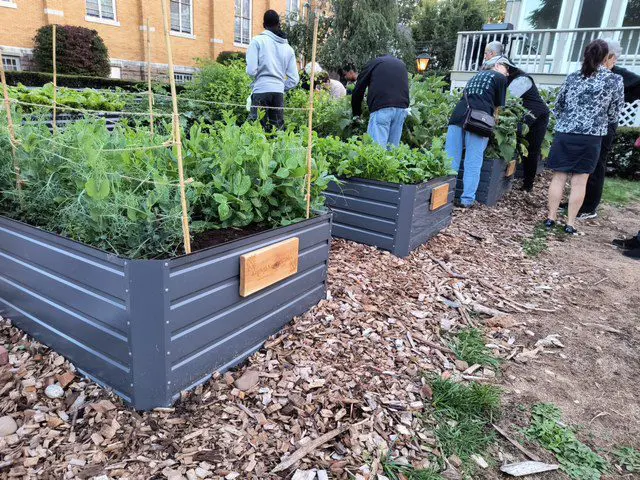
Today, as coordinator of the St. Joseph the Worker Garden of Blessed Michael McGivney Parish, he and a team of volunteers are providing that same pleasure, and nutritional benefits, to scores of families each week by growing organic tomatoes, eggplants, bell peppers, cabbage, kale, spinach, squash, lettuce and a lot more to help feed those in need.
“There are so many people who don’t have access to healthy food,” Fama says. “They might not because of grocery store prices or perhaps there are ‘food deserts,’ where they need to travel far to get healthy food. So this fills an important gap.”
The community garden at St. Joseph Church on 129 Edwards St., in New Haven, is a social justice initiative of McGivney Ministries group. In its first year, the garden yielded more than 400 pounds of produce that was donated to St. Bernadette of Lourdes Food Pantry on Townsend Avenue, which provides food and other necessities to people, he says.
The discussion about starting a community garden began in late 2022, and by spring the following year, the group broke ground. Along the way, they received assistance from private individuals and a number of nurseries and farms, which donated seedlings, soil and mulch.
The group also got grants — and advice from a master gardener — from the Interreligious Eco-Justice Network, a Connecticut organization focused on environmental stewardship, whose mission is to “inspire and equip Connecticut’s religious communities to protect our planet through education, engagement and advocacy.”
“For us, it has been important in terms of building community and bringing people together to be out in nature, which is good for your mental and spiritual health because it provides a place for belonging,” Fama says.
Some individuals who have benefited by receiving the produce also help with the gardening.
“It’s touching people’s lives in an important way, rather than just given them something,” Fama says, adding that the St. Joseph the Worker Garden has three goals, inspired by Pope Francis’ encyclical Laudato Si’: to build community, to educate and to serve.
“The garden helps the earth by making good use of parish land to promote a healthy local ecosystem,” Fama says. “It also helps those in need by providing them with free food.”
This upcoming growing season, the garden will be using 12 raised beds after a soil test found traces of lead.
“By the grace of God and many generous supporters, the raised beds were eventually assembled and filled,” Fama says. “Looking ahead to the 2025 growing season, there’s definitely a lot of potential. In the spring, we plan to plant in all 12 of the raised beds, which we couldn’t do last year.”
In addition, the volunteers hope to add an educational component to their efforts by offering workshops that provide practical skills and strategies to promote sustainability.
“We need help with hands-on work, such as planting, watering, weeding and harvesting,” Fama says. “There are also opportunities to join our administrative team, which is engaged in tasks such as fundraising, planning and implementation, and outreach.”
Those interested in volunteering do not have to be parishioners, Fama says. The group also welcomes donations of vegetable or herb seedlings, garden tools, supplies or money.
A list of volunteers is being coordinated for the upcoming season of St. Joseph the Worker Garden of Blessed Michael McGivney Parish in New Haven. To participate or for further information, contact Liam Fama at mcgivneyministries@newhavencatholic.org.
Archbishop Coyne Leads Local Catholics in Praying for the Soul of Pope Francis
Story by Shelley Wolf
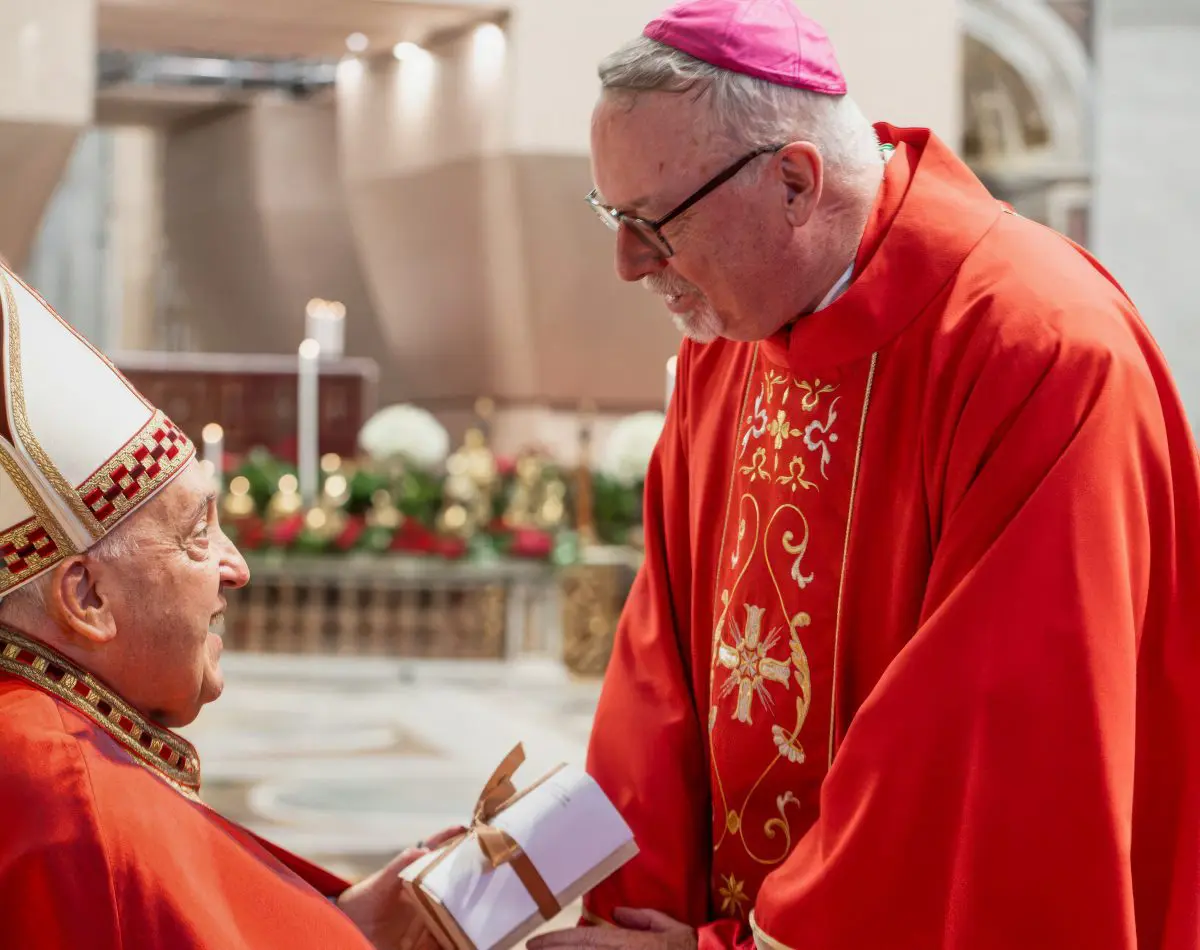
Archbishop Christopher J. Coyne led local Catholics gathered at the Cathedral of St. Joseph in Hartford in praying for the repose of the soul of Pope Francis just hours after the Holy Father’s death on April 21, 2025, the Monday after Easter. Pope Francis was 88.
The archbishop, more than a dozen priests and deacons, and Governor Ned Lamont took the opportunity to assemble at the Cathedral’s noontime Mass along with area Catholics and people of other religious faiths to reflect on, and pray for, the beloved pontiff.
“His was a prophetic voice, constantly seeking to move us out of the comfortable middle of life and faith to the margins of society,” Archbishop Coyne told all those in attendance. “While doing so, he continued to maintain the Church’s deposit of faith and doctrine. His off-the-cuff remarks and interviews were honest, sometimes outrageous and always interesting.
“Over the past few years, he suffered from many ailments and illnesses, but he always kept plugging along as our Holy Father with his usual grace and humor,” the archbishop observed.
Bringing context to the solemn day, Archbishop Coyne noted that Catholics have been blessed in recent decades in the Catholic Church by three popes: St. John Paul II, Pope Benedict XVI, and Pope Francis.
According to Archbishop Coyne, Pope John Paul II wrote “exhortations and letters of all kinds on all subjects,” while Pope Benedict “set his heart and his papacy on combatting the scourge of relativism in the Western Church.” Then came Pope Francis, with his emphasis on God’s mercy and on reaching out to those on the peripheries of society.
Despite their differing styles and contributions, all three popes faithfully served the Church, the archbishop said, and served in a unifying role by occupying the chair of St. Peter.
“Regardless of the humanity of the man who sits in that chair, we honor and respect him as the successor of St. Peter,” Archbishop Coyne said, “knowing that our faith is grounded on the rock of St. Peter and guided by Jesus’ own prayer that all may be one.”
Governor Ned Lamont also addressed those in attendance at the Cathedral.
“We all love Pope Francis because we knew that he loved us unconditionally and he reminded us every day, through the example of his life, that we’re all God’s children,” Governor Lamont said.
“And I think today we miss Pope Francis more than ever because we need him more than ever,” the governor added. “I hope we always live in his example. We have so much more in common together than anything that could divide us.”
Local Priest Publishes Book Exploring Paths to Conversion
Story by Shelley Wolf
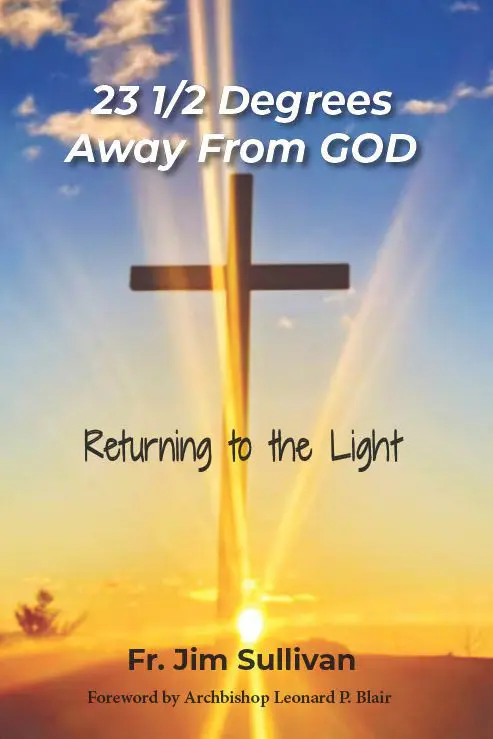
In his book 23 1/2 Degrees Away From GOD: Returning to the Light, Father James M. Sullivan traces his family’s history back to the town in Ireland where his father was born. He’s on a mission to discover whether the seemingly tall tales his father told about traveling to church on Sunday were really true.
That’s the charming start to Father Sullivan’s book, which sold all 1,500 copies of its first printing in 2024. Now in its second printing, the book is expected to be available again in time for the Easter season.
The book is sprinkled with fond recollections and lessons learned from his parents, siblings and time spent as a building contractor. However, Father Sullivan, now rector of the Basilica of the Immaculate Conception and pastor of Immaculate Conception Parish in Waterbury, insists the book is not a memoir.
“I didn’t want it to be a memoir,” he says in an interview with Catholic Transcript Online. “I just tied it to the small things in real life. God is big on the little.” The book’s purpose, he says, is to explore the many paths to conversion in adults of all ages.
Published by Highbury Press in Waterbury, the book features a cover photo of Waterbury’s Holy Land USA at sunrise, which was taken by Father Sullivan’s brother, John Sullivan. The second printing includes a forward written by Archbishop Leonard P. Blair.
Written in accessible language, the paperback book discusses human nature and conversion through the eyes of a priest, drawing inspiration from personal anecdotes and various perspectives on conversion.
A first-time author, Father Sullivan took three years to complete the manuscript, writing on his days off and while on retreat. Before he became a priest, he always wanted to write a book on human nature, he says, but never did.
“And then, as a priest, you see conversions all the time, people coming back to church and their reasons why, and what touched them and how their life was affected,” he says. “So, I decided to write a book on conversion because every person ultimately desires it, to become closer to the source of all love and life.
“I have a special calling for those who are somewhat lost,” Father Sullivan adds. “Maybe because I was in the building profession for so many years and in the working world, I feel like I really know the heart of the average person. Many have good hearts but don’t know God. I want to show them who Christ is.”
And everyone needs ongoing conversion, the priest says, to avoid “spiritual stagnancy.”
In the pages, Father Sullivan also shares a priest’s thoughts on the importance of Christian marriage, Catholic confessions, Mass attendance and vocations to the priesthood and religious life. And he doesn’t forget to share the joy of the priesthood. “I believe a lot of vocations are out there. They just need to be encouraged and touched,” he says.
The book urges all readers to find their calling and to pray for guidance. It prompts readers to pray and to listen in prayer, with special emphasis on listening.
All proceeds from the book go to Immaculate Conception Parish. The second printing will be available sometime after Easter. To order a copy, keep checking the publisher’s website at highburypress.com and highburypress.com/fatherjimbook.