Skip to content

Old Pipe Organ Finds New Home at Pastoral Center

Story by Shelley Wolf

An old pipe organ that fell silent in Enfield is now living a new life in Bloomfield, where it is captivating Catholic music-lovers once again.

Having served parishioners for many years at St. Adalbert Church in Enfield, the pipe organ is now providing music for the liturgies at St. Thomas Chapel at the Pastoral Center in Bloomfield, where it is being enjoyed by archdiocesan employees and invited guests.

The organ from St. Adalbert Church was built in 1986 by J. W. Walker & Sons, currently located in Devizes, Wilshire, England, and it was installed at St. Adalbert that same year.

“It’s rare because Walker only built about eight in America,” says Stephan Maier, owner of Stephan Maier Tracker Organs in Orange, Mass., who services organs throughout New England. Maier honed his specialized craft, learning to repair and tune organs in his homeland of Germany.

The organ, which served the St. Adalbert community, became available after the community was merged into St. Jeanne Jugan Parish in 2022 and the church was subsequently closed in 2024.

Maier’s work on the organ began last September. “An instrument like this is not like a piano. You can’t just roll it into a truck, and then roll it into a new place,” Maier says. “You completely dismantle it, and then you completely reassemble it and, in the process, we check all the pieces and we refurbish what needs to be refurbished.”

“Every instrument is unique,” he adds. Working on each pipe organ is “like building a house.”

After reassembly and repairs, Maier’s team returned in January to complete the job. “We make some adjustments to the sound of the organ, what we call voicing, the tonal work,” he explains, “because that needs to be adjusted to the building now that the organ is at St. Thomas Chapel.”

According to the Pipe Organ Database of the Organ Historical Society, the pipe organ from St. Adalbert was built in a traditional design, with hinged doors that enclose the keyboards. It is a classic “mechanical stop action” instrument with two manuals (keyboards) and 24 stops (knobs that indirectly control the air flow over the pipes), with draw knobs in vertical rows and a concave radiating pedalboard.

Pipe organs produce sound by driving pressurized air through the organ pipes as directed from the keyboard. This organ is known as a “tracker organ” because it uses “trackers,” or thin strips of wood, to create a pulling motion that links the key or pedal pressed by the organist to the valve that allows air to flow into the pipes.

“In the genre of pipe organs, there are mechanical organs and organs that are still pipe organs but they have an electric action. This one has a mechanical action path. And therefore, it’s called a tracker organ,” Maier says. “So, the only electric part in this instrument is actually the blower that generates what we call the wind, or the air pressure for the organ.

“But everything else is strictly mechanical and, in that sense, it is a little more complicated than, say, an electric action organ, where you just have a bunch of wires and contacts and magnets,” he explains.

“And essentially this [mechanical] type of organ is what Bach and Mendelssohn played on,” Maier notes, “because in those days there wasn’t electricity, so it was all mechanical.”
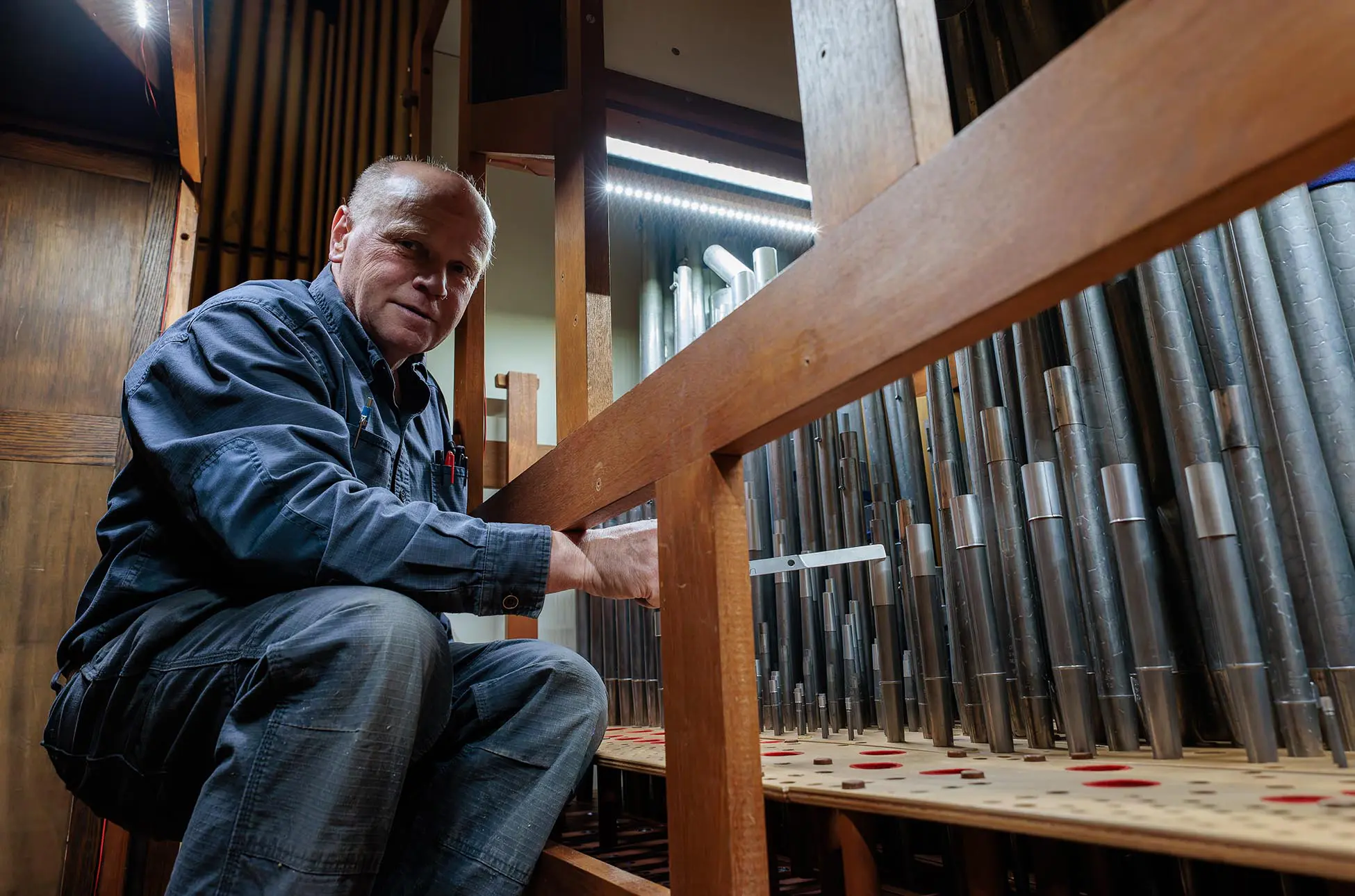
Stephan Maier, owner of Stephan Maier Tracker Organs, tunes the organ pipes. Photo by Aaron Joseph

‘I say a little prayer for you…’

Column by Joe Pisani

About 10 years ago when I was working in Manhattan, I got off the train in Grand Central Terminal and made my way through crowds of commuters to Lexington Avenue and onto Fulton Sheen Place near the Church of St. Agnes. 

Suddenly, I found myself behind a young woman, walking and talking on her phone, who started sobbing, “I don’t know what I’m going to do! I don’t know what I’m going to do!” 

Her agonized cries made me imagine a hundred tragic possibilities that could have brought her to such despair, one more painful than the next, and so I did the first thing that came to mind and uttered the words, “Jesus, help her. Jesus, please help her.” 

It was my introduction to a practice that’s turned me into a sort of spiritual EMT — praying for complete strangers, some of whom may not even understand the efficacy of prayer or have no one to pray for them. And it’s very apparent that the world is populated by people who need prayer. Correction: The world is overpopulated by people who need prayer.

The causes of their despair are many: a friend dies, a child dies, a spouse dies and the grief is debilitating. A relationship ends, a job is terminated, a mortgage can’t be paid, and a betrayal cuts to the heart. Loneliness, depression, mental illness, emotional abuse, physical abuse, a potentially fatal diagnosis. The list goes on and on, and should remind us of one certainty in this life: Everybody needs prayer. 

So, if we’re only praying for people we love, including our family members and friends, we’re not doing enough praying. Jesus said to pray for our enemies, and I’d add that we need to pray for complete strangers, for people we don’t even know.

Whenever my wife and I are driving on the highway and she hears an ambulance siren and sees the flashing lights, she immediately stops talking, makes the Sign of the Cross and says a Hail Mary for the person in distress. It’s a spiritual 911 call. She did it recently when our grandson was in the car and promptly encouraged him to start doing the same thing.

A few months ago, I came upon a book by author River Jordan titled, Praying for Strangers: An Adventure of the Human Spirit, in which she recounts her New Year’s resolution for 2009, when her two sons were going to war in Iraq and in Afghanistan, and she realized the most important thing she could do would be to pray for their safety. 

She also made a resolution to focus on praying for strangers rather than herself. A different person every day. The results — as are all results when Jesus gets involved — were nothing short of miraculous.

I know several people who pray for strangers, living and dead. My friend Linda and her Maltese-terrier Peaches spend their mornings walking through a cemetery near their home and frequently pause to say a prayer at the grave of someone the Holy Spirit inspires her to pray for, including veterans from as far back as the Civil War.  

“As I walk around, I look at the graves and make the Sign of the Cross and say a few prayers, adding, ‘I hope you’re resting in peace.’ I feel close to them all,” she says.

My friend Jenine does the same thing in her work.

“I realized very early that while driving through the cemetery, monuments became reminders of the families I had come to know and care about,” she said. She asks God to bless them and comfort their families.

“My prayers are nothing elaborate, just short and sweet heartfelt words to God,” she says. “They are simple prayers, which over the years have become part of my everyday prayer life.”

She says that whenever someone comes into your mind, you should consider it an invitation from the Holy Spirit to say a little prayer for them. 

Do you remember that Dionne Warwick song, “I Say a Little Prayer for You”? It doesn’t take much time. It doesn’t take much effort, but the benefits are incalculable, and we’ll never know the full effect that our prayers have had until the next life, when Jesus pulls aside the veil.

Then, we’ll be able to see the countless troubled, lost and lonely souls who were helped by our simple prayers. They were once anonymous strangers, but someday when we meet, they’ll be our grateful friends.

Prayers for Priests and Deacons

Monthly calendar helps people develop ongoing prayers for men who answer God’s call

Story by Karen A. Avitabile

Anna Maria Dias calls herself a “prayer warrior” and welcomes others to join her.

For the past 10 years, she has designed prayer calendars which includes the names of priests of the Archdiocese of Hartford. In addition, she designs a separate calendar each month for the deacons of the archdiocese. The calendars are distributed through email. 

“I never heard of anyone saying they pray for priests,” Dias says. “The thought of praying for priests was foreign to me.”

The goal of the calendars, she says, is to keep the ministry of the priesthood and diaconate in everyone’s heart and mind. “They see the struggles and everything the people deal with every day,” Dias says. “It’s a lot of burden to carry.”

For the priest’s calendar, a different  name is printed in a square for each day of the month, with two squares always devoted to Pope Francis and Archbishop Christopher J. Coyne.  

Dias became interested in praying for priests after learning about the Handmaids of the Precious Blood, a contemplative community in Tennessee which prays for priests and promotes the glory of God.

In 2012, Dias became an Oblate of the Precious Blood in 2012. She heard about a prayer calendar for priests in other dioceses and went to work right away to design one for the Diocese of Springfield, Mass., where she resides and prays. 

After some Connecticut parishioners heard about the Springfield prayer calendar, they contacted Dias and asked if she could produce one for priests within the Archdiocese of Hartford. She began the local calendar here in 2015. Shortly afterward, a calendar for deacons followed.

At the top of the calendar each month, Dias prints a prayer which expresses gratitude to God for priests who have answered the call to ministry. The February prayer reads: 

“We thank you God, our Father, for those who have responded to your call to priestly ministry. Fill your priests with the sure knowledge of your love, lead them to new powerful consolation of the Holy Spirit. Increase their profound faith in the sacraments they administer. Grant that your priests may inspire us to strive for holiness by their good example. Heavenly Father, guard your tender care upon these chosen ones, so dear to your infinitely considerate heart.”

A message from Father Gerald Fitzgerald, who founded the community of Handmaids of the Precious Blood in 1947, is also included on the bottom of the calendar. 

His current message is: “Be not afraid! When the brief moment of your life is over, the great high priest will come to you and let you take your place in his heart; for what you did for his priests was done for him.”

Father Anthony Federico, director of Vocations for the Archdiocese of Hartford, receives the priest calendar each month. “It’s a beautiful gesture to take ownership of promoting vocations in the Church,” he says. 

The Archdiocese of Hartford, he adds, is seeing an increase in vocations through several efforts including parish vocations committees, praying the Prayer for Priestly Vocations, parish holy hours and rosaries, the St. John Vianney Vocation Prayer Society and the priestly prayer calendar. 

Dias says is looking for more prayer warriors. “The more prayers warriors, the better,” she adds.  

To be placed on the distribution list for the monthly prayer calendars for priests and deacons, email Dias at faithfirst@1791.com.

“Doing the calendar gives me peace to know I’m trying to help the priests with prayers,” she says. “It keeps my mind focused.”

2025 Respect Life Masses and Marches Underway

Story by Shelley Wolf

For those who recognize the value of all life, the early months of the year offer many opportunities to publicly declare the sanctity and dignity of every human person.

On Jan. 19, Archbishop Coyne was the main celebrant for a Pro-Life Mass & Baby Shower Collection at St. Mary Church in New Haven, part of Blessed Michael McGivney Parish. Sponsored by the Knights of Columbus, the Mass provided time for prayer and the chance to donate baby items for the Connecticut Pregnancy Resource Centers.

Mary, Gate of Heaven Parish hosted a Mass for Life on Jan. 20 at St. Robert Bellarmine Church in Windsor Locks. Father Michael Ruminski, pastor of Sacred Heart Parish in Bloomfield, was the main celebrant and offered a reflection after the Mass. Prior to the Mass, pro-life advocates recited the rosary for life.

The 2025 National March for Life, set for Friday, Jan. 24 in Washington, D.C., is billed as the largest annual human rights demonstration in the world.

Although Roe v. Wade was overturned by the U.S. Supreme Court, Sister Suzanne Gross, program coordinator for the archdiocese’s Respect Life Ministry, says it’s important to keep marching. “We’ve changed the law but we haven’t changed the hearts and minds of people,” she says. “We’ll still be making a statement. So that’s why we go.”

The Archdiocese of Hartford pilgrims leave from the Franciscan Life Center in Meriden on Jan. 23 to attend the Vigil Mass for Life at the Basilica of the Immaculate Conception in Washington, D.C. Next day, they will enjoy a Mass at the Washington Plaza; a concert by the Christian band Unspoken at 11 a.m.; the rally at noon on the National Mall with keynote speaker Bethany Hamilton, a professional surfer who persevered despite her disability; and the March for Life at 1 p.m. to the U.S. Supreme Court.

Closer to home, the 2025 Connecticut March for Life is slated for March 19, and there’s still plenty of time to register and sign up for buses.

The rally begins at noon at the Connecticut State Capitol, located at 210 Capitol Ave. in Hartford, followed by the march around Bushnell Memorial Park and along Main Street at 1 p.m. The Connecticut Pregnancy Care Coalition will also host a student sign-making contest between 11 and 11:45 a.m.

“The March shows the importance of what prayerful witness is all about. We’re marching for the unborn, who cannot speak for themselves, and for humanity and the dignity of every human person,” says Father Glen Dmytryszyn, director of the archdiocese’s Respect Life Ministry. “With the inception of human life, all other rights follow. What else can we march for?”

Christopher Healy, executive director for the Connecticut Catholic Public Affairs Conference, strongly recommends participating in the Connecticut March for Life. “Your attendance,” he says, “will help send the message to lawmakers that we will not allow laws to be passed that do not respect God’s greatest gift to us all.”

Before You Go: For more details about the Connecticut March for Life, including a map, parking, buses from local parishes, and other events that day, visit marchforlife.org/Connecticut. For more information on legislative matters from the Connecticut Catholic Public Affairs Conference, visit ctcatholicpac.org.

The 2025 Connecticut March for Life is sponsored by the National March for Life, the Connecticut Catholic Conference and the Family Institute of Connecticut.

Prayer Shawl Ministry Shares God’s Love with Others

Story by Joe Pisani

It began with a dream. A dream about knitting prayer shawls.

“Every night, a voice in my head told me this would be a wonderful thing to do; I could even visualize the shawls and passing them out,” says Maria Batick of St. John Bosco Parish of Branford. “The voice was persistent and told me, ‘just do it.’” 

She did, and almost 18 years later, the ministry still brings God’s love to people. At the time, Batick was president of the Mutual Respect Committee at Yale New Haven Hospital, where she started an initiative to distribute “comfort shawls” to patients.

Prompted by a voice she believes was the Holy Spirit, she went to senior centers and churches throughout the region, asking them to knit shawls for the sick and dying.

“The chaplain would say a prayer before we handed them out,” Batick recalls. “People who were dying received them, and later their families kept them because they meant so much.”

Upon retiring in December 2015, she started the prayer shawl ministry at St. John Bosco Parish, which includes St. Mary and St. Therese churches, where the knitters continue to distribute shawls and blankets to the infirm, baptized infants, those confronting a crisis and anyone who requests one.

“They’re given away for many occasions,” she says. “We don’t ask. They are in the rectory to be taken. They are made with love, given away with love and received with love.”

Joanne L. Fresco, the parish pastoral associate for sick and elderly, also gives pocket prayer shawls with miraculous medals to homebound people she visits. Hundreds were even given to schoolchildren for their backpacks. 

They have so much meaning. One man takes his with him when he receives chemotherapy, Fresco adds. Another person, she adds, holds it when he’s uncomfortable or praying. 

Batick says she is convinced the Holy Spirit inspires the knitters because there have been many occasions when someone received a shawl and responded, “How did you know that was my favorite color?” Or, “How did you know this color matched my room?”

“I tell the knitters, ‘You don’t know who you’re knitting for, but it will go to the right person because it is directed by God’s love,’” she says.

In the past, Batick recalls a bold orange and red prayer blanket she had on hand for more than a year before giving it to an elderly man, who began to cry in appreciation. “How did you know I was a fireman?” he asked her. The colors reminded him of flames.

The group of eight women gathers monthly at St. Mary Church and prays for God’s guidance during their knitting sessions. They later continue their work at home. 

The Blessed Virgin is the patron of the ministry, which Batick began in her honor in appreciation for “everything she has given me.”

“These shawls are a gift from God,” she says. “The knitters are so happy to make them. Whenever I tell them stories about the happiness their shawls give people, they want to do even more. Only when they get to heaven will they understand all the joy they gave to people.”

(The prayer shawl ministry of St. John Bosco Parish meets at the parish hall, 731 Main St., in Branford, on the second Wednesday of the month from 9 a.m. to noon. For more information, call Maria Batick at 203.488.7426.)

First Poster Highlighting Women’s Vocations Accompanies Seminarian Poster

Story by Shelley Wolf

If you take a look around your parish or Catholic school, you may notice two large new posters pinned to the bulletin board or placed on easels, putting a spotlight on vocations. And if you do a double take, that’s to be expected.

This year, to double its efforts highlighting vocations, the Archdiocese of Hartford is publishing two vocation posters: one for men discerning a call to the priesthood and one for women who are exploring a call to consecrated religious life.

In a first, the Office of Vocations has partnered with the Delegate for Religious to publish a poster of women aspiring to the religious life, in addition to the annual seminarian poster.

“I’m happy with the joint effort. I think it’s a step forward in the complimentary nature of our two offices,” says Sister Barbara Mullen, delegate for Religious for the archdiocese and a sister of St. Joseph of Chambéry.

A total of 520 posters, 260 of each, were printed in early December. Two of each were delivered last month to Catholic parishes, elementary schools, high schools, colleges and religious communities.

The idea for the women’s poster was forwarded by administrative assistant Maura Dooley of the Office of Vocations, who attended the National Conference of Diocesan Vocation Directors last summer and heard a panel discussion about promoting women’s vocations on a poster alongside the men’s poster.

“Maura thought it was a great idea and told me about it,” says Father Anthony Federico, director of Vocations. “I brought it to Sister Barbara and she was on board as well, and Sister Barbara designed it herself.”

To start the process for the women’s poster, Sister Barbara reached out to the religious orders. “I contacted all the orders in the archdiocese and asked if they had any women in stages of formation,” she says, “from postulants through novices, and including temporary professed.”

Five different communities forwarded 28 names along with their photos. Sister Barbara published first names only to protect the privacy of the discerners, who are free to drop out at any time. The men’s poster, which includes the names and photos of 11 seminarians, was already in progress.

Now, Sister Barbara is hoping that parishioners throughout the archdiocese will pray for the discerners, providing prayerful support.

“Both Father Federico and I are hoping the first thing to come out of this is prayer, that people will understand that we have men and women who are searching,” she says. “We have all these men and women who are in the process of discovery.

“I hope they feel the wealth of prayer coming back to them, by name perhaps,” Sister Barbara says, “as people read the posters and call out a name.”

In another first, this is the first time that either vocation poster has been sent to any Catholic schools. Sister Barbara credits Father Federico for suggesting it. “In schools, the posters will let young men and women know this could be a viable option in life,” she says. “In reality, most people don’t think about it.”

At 2-feet-by-3 feet, both posters are much larger than the seminarian poster of past years. “With everything the Lord is doing in the Archdiocese, we thought it was the right time to make it bigger,” Father Federico says. “I hope parishes and schools will display the posters prominently.”

For more information on vocations, contact the Office of Vocations via email at vocations@aohct.org or call 860.761.7456. For more information about different forms of professed religious life, contact Sister Barbara Mullen at sr.mullen@aohct.org or call 860.242.5573 ext. 7492.

Remnants of a Life Well Lived

Story by Joe Pisani

You never know what you’ll find when you sort through the belongings of someone you love who’s died. There are all sorts of curious and strange discoveries, some that console and others that startle, and still others that disappoint. 

It’s like walking through a doorway that takes you to a place you’ve never visited before, resurrecting memories that cause laughter and, of course, tears.

It was that way with my father, who died on Christmas Eve 20 years ago. He was a recovering alcoholic, who lived the last 25 years of his life sober. But we won’t talk about the first 50. 

I knew sobriety had made him a new man, but I never realized exactly how much he’d changed until I was going through his room in the weeks after his passing. Some things struck me as odd — like the collection of brand new socks in the bottom drawer of his dresser. There were dozens of pairs of socks still in their packaging. 

I thought he might have been a hoarder because he demonstrated all the characteristics, until one of my cousins reminded me that he and his eight siblings grew up during the Great Depression on the East Side of Bridgeport — with only a widowed mother to care for them — so  they didn’t have socks and had to line their shoes with newspaper. 

In later years, those memories prompted him to buy more socks than he could ever wear in one lifetime because he was determined never to go barefoot again.

My exploration led to other curiosities, including a little shrine on his bureau that had a statue of the Blessed Mother and a crucifix, along with a votive candle that was perpetually burning, to the chagrin of my mother because the flickering flame produced a smoke stain on the ceiling. This shrine defined his new life of sobriety, and my father didn’t care at all about the stain.

To appreciate his spiritual transformation, let me share a painful memory of him during the dark days: He would sit in his Barcalounger, watching war movies, while holding a water glass of Canadian Club whiskey in one hand and a 16-ounce can of Budweiser in the other.

But 12 Step programs like Alcoholics Anonymous work miracles. To the day he died, he credited his Higher Power, whom he chose to call God, and the men and women of AA with his sobriety. He’d often say that the program didn’t open the gates of heaven to let him in, but it definitely opened the gates of hell to let him out.

In his last 25 years, the Budweiser and Canadian Club disappeared. In one hand, he held a cup of black coffee and in the other, his prayer book. He took his sobriety seriously, and he knew that meant he had to be serious about his spiritual progress. However, I never realized how serious until the day I was cleaning out his room.

There, beside the votive candle, was a small black book filled with names. When I looked closer, I realized it contained the names of men and women who had passed away. Some of them died from the disease of alcoholism, others had been given the gift of sobriety. There were also dozens of family members and friends from the East Side, along with people I never knew, but who had crossed his path in life … so he prayed for them all every day.

Nestled inside the book was a collection of remembrance cards held together with an elastic band. The cards memorialized the deceased, and he got them at their wakes and funerals. He treasured them and he regularly prayed for those people in the hopeful assurance they would make it to that place we’re all destined to reach when this life ends — that place where there’s no suffering, no addiction and only love, peace and perpetual joy.

I took the prayer cards home and added them to my own collection. Every so often, I take them out, and one by one I’ll pray for the souls of the faithful departed. I’m convinced that when we pray for them, we can be assured they’re also praying for us.  

Connecticut Catholic Conference Lays Out Plan Ahead of 2025 Legislative Session

Story by Joe Pisani

With the Connecticut Legislature getting underway for the new session next week, Chris Healy, executive director of the Connecticut Catholic Public Affairs Conference, is preparing for several challenges that include protecting the sanctity of life, the right to freely practice religious faith amid growing antisemitism, school choice options and social justice issues.

The session officially starts this Jan. 8 and ends June 4. In the coming weeks, the Conference is anticipating some lawmakers may submit bills that threaten the Catholic faith. 

“We must prepare for proposals that further abortion practices, that legalize assisted suicide, further harass pregnancy care centers and assault the religious directives Catholic hospitals operate under,” Healy says. “The proponents of these initiatives are supported by national organizations that are not reflective of Connecticut voters.”

The Conference is the public policy and advocacy office of the Catholic bishops in Connecticut which supports or opposes legislation. Its mission is to work with elected officials at the state and federal levels to influence public policy and stand with other faith groups to promote and ensure a better life for all. 

At the top of the Conference’s agenda is the issue of biological males participating in girls’ sports and laws regarding transgender surgeries of children.

The Conference advocates Title IX protection of young women the right “to participate in the same scholastic sports as males by prohibiting discrimination based on sex in education programs and activities,” Healy says. 

In recent years, the definition was expanded to include transgender males. “This created an unfair reality that bolstered men competing in women’s sports at all competitive levels with the full protection of the federal government,” he says.

Another issue of concern, he adds, is school choice which would give parents “the freedom to guide their children’s future while allowing public funds to follow the child.”

“We will be trying to get something on the books in Connecticut that will allow for people to support school choice financially and get some kind of tax benefit, which will allow more kids to go not only to Catholic schools, but any other school that fits their needs,” Healy says. “We need to help them pursue their dreams, especially if they’re in a failing school district or they’re restricted by their zip code from getting a decent education.”

Religious freedom, which is guaranteed under the Constitution, has faced growing challenges in recent months with acts of antisemitism on college campuses and in the public arena, the executive director says, adding the Conference will work to bring greater public awareness to the problem.

The beginning of a legislative session usually brings a new Connecticut General Assembly based on changes of elected legislators in the 2024 election, Healy says. “There’s always the unknown, but we know what we have to do. We have to get Catholics and others who share our views engaged so their voices are heard. If we organize and do that and follow God’s blessing, we’ll be fine.”

In the past, the Conference has partnered with other faith groups to support issues of faith.  

“They share our values on these issues and they appreciate the fact that the Catholic Church has asked them for their help and that we help them as well when we can,” Healy says. “They helped us  in opposing assisted suicide, and hopefully we can do that again this year on other issues.”

Healy urges people to get involved with their local elected state legislators to oppose any proposals that come before the Legislature that threaten Catholic teachings. For more information about the Connecticut Catholic Public Affairs Conference, visit ctcatholicpac.org.

Catholic Transcript: December 2024

Catholic Transcript: November 2024