
Century-Old Bishop’s Ring Is Discovered in the Archdiocese of Hartford
Story by Shelley Wolf
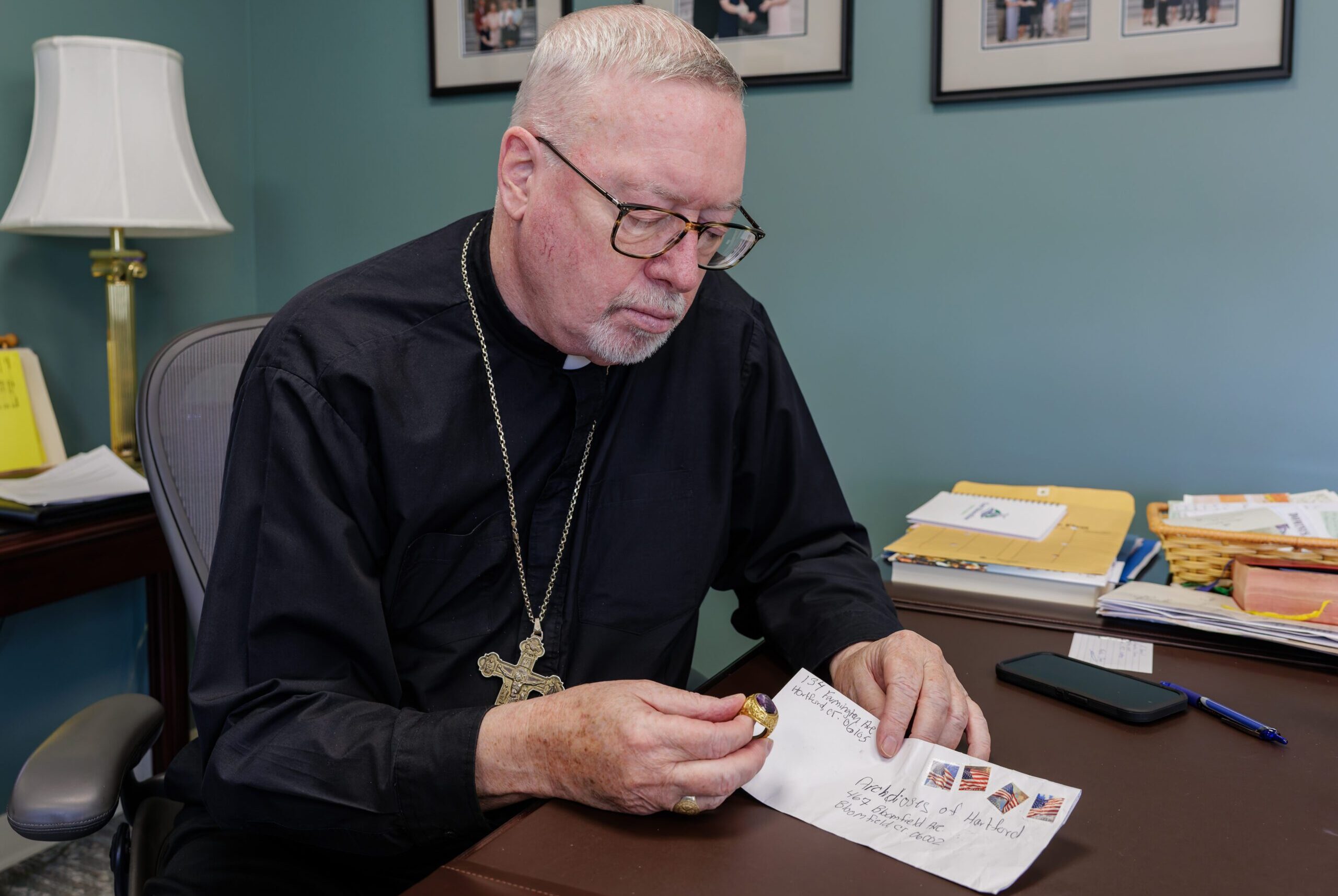
On the Monday after Easter, an archdiocesan employee sifted through a very large pile of mail at the Archdiocese of Hartford’s Pastoral Center in Bloomfield.
After opening a white letter envelope addressed to the Archdiocese of Hartford, she was taken aback by what she found inside and immediately delivered it to the office of Archbishop Christopher J. Coyne.
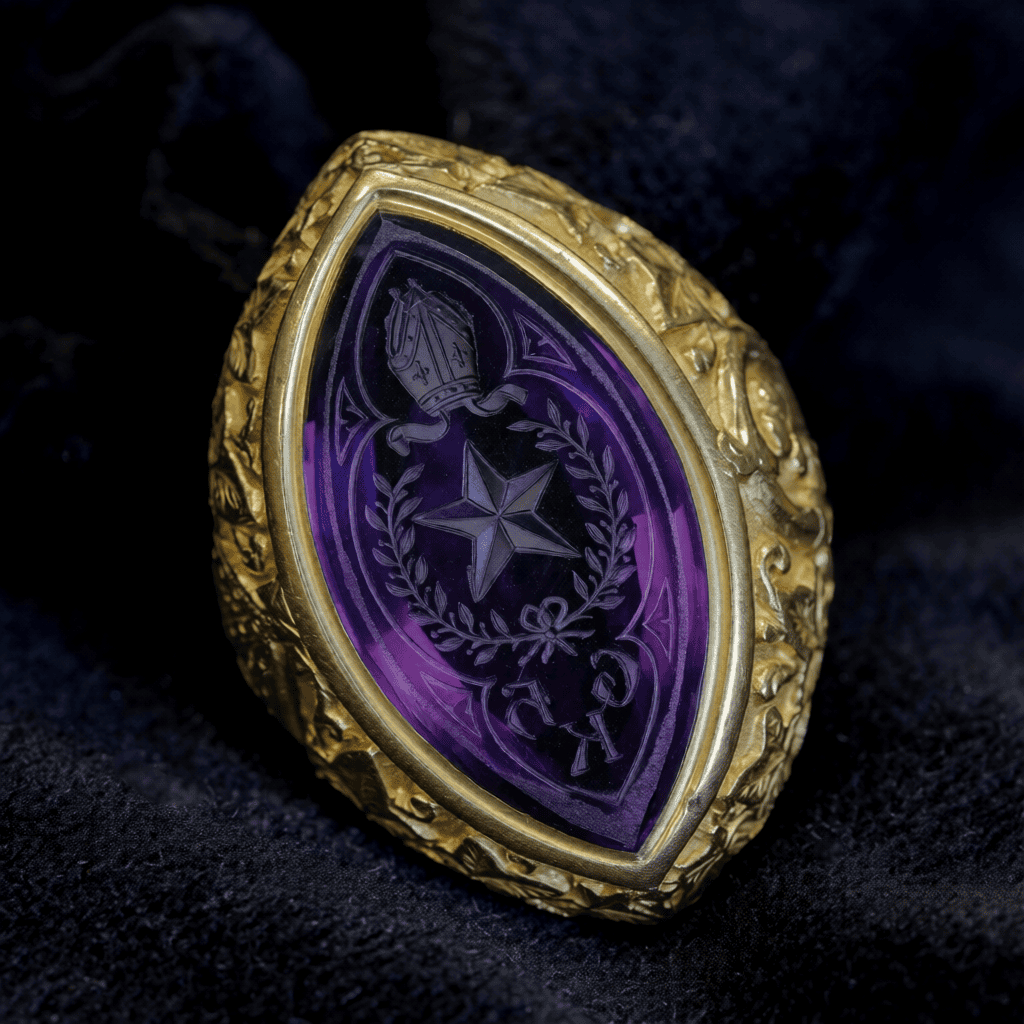
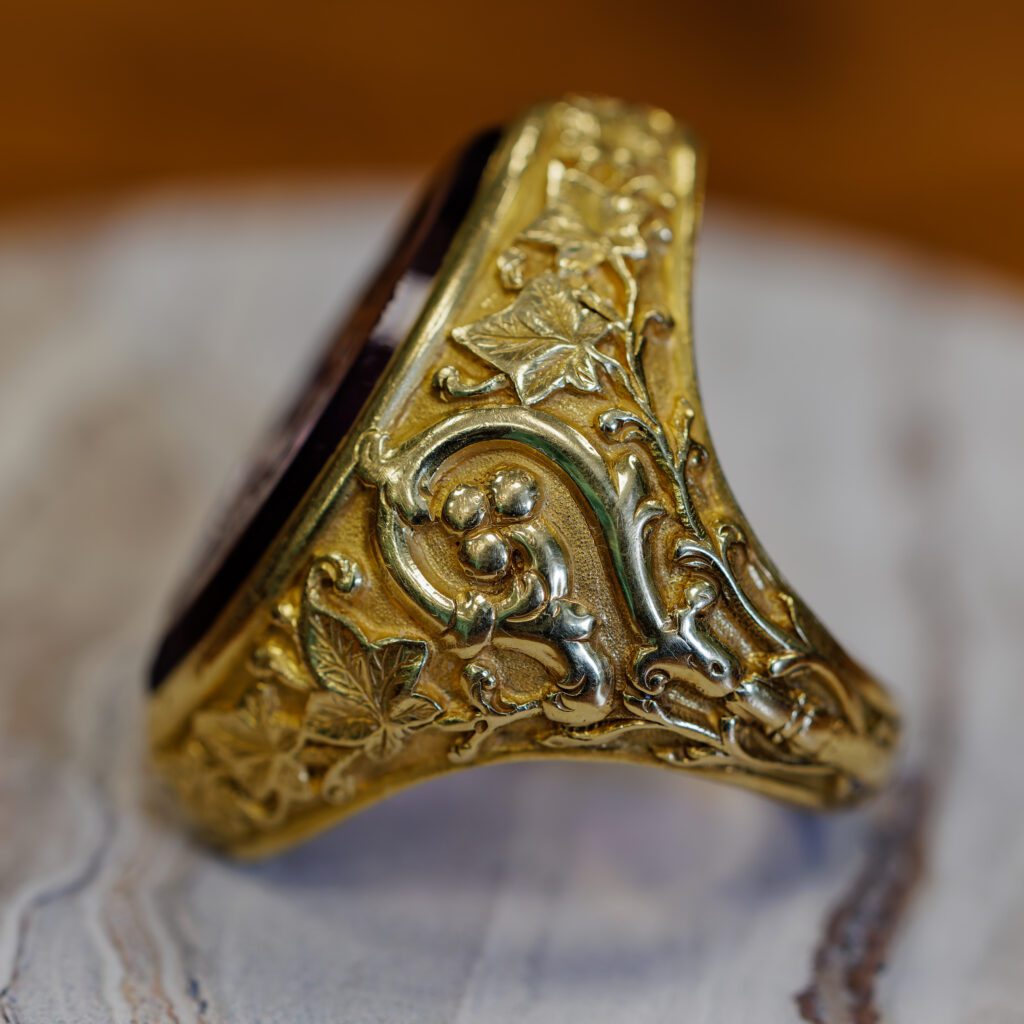
Inside was a hefty gold ring with a large purple stone. Images, a bishop’s crosier and a mitre, appeared in relief on either side. The stone, possibly an amethyst, was etched on the front with a mitre, star and three initials: “GHK.”
Archbishop Coyne confirmed it was a bishop’s ring, typically presented at ordination to signify the bishop’s apostolic ministry and fidelity to the Church.
Words etched inside the gold band offered more clues to its owner: “From W.M.J. to his beloved friend G.H.K. AD1892 Mizpah.”
“‘Mizpah’ is a greeting of affection by people who are separated by distance,” Archbishop Coyne says. Still, everyone in the archbishop’s office was puzzled.
“When the ring was first brought to my attention, I took it as a bit of a mystery since it was clear that it was not the ring of any of my predecessors here in Hartford,” Archbishop Coyne recalls. But perhaps it belonged to a bishop in another Catholic diocese?
“Working with my staff, we were fairly quickly able to discern that it was not the ring of a Catholic bishop, so we branched out into other Christian faiths that have a tradition of bishops,” Archbishop Coyne notes.
After online research failed to match to a Catholic bishop, living or dead, the archbishop’s team searched for bishops in the Episcopal Church and found a match in multiple online sources. They found those initials around 1892 and the more they kept digging, the more they kept finding.
G.H.K. appeared to be Bishop George Herbert Kinsolving, who was appointed assistant bishop of the Episcopal Diocese of Texas in 1892 and a bishop of Texas in 1893, according to the Texas State Historical Association.
A visionary, he is remembered as the founder of All Saints’ Episcopal Church on the University of Texas campus in Austin. Seeing an opportunity to reach students, he initially built the Gothic Revival church as a chapel, which opened in 1900, to serve both female and male students.
Kinsolving died on Oct. 23, 1928, and was buried in Oakwood Cemetery, Austin, until his body was moved in 1940 to a crypt in what is now All Saints’ Episcopal Church.
With this information, the Archdiocese of Hartford contacted the Episcopal Diocese of Texas and the office of its current bishop, Bishop C. Andrew Doyle, in Houston. The archdiocese shared the discovery of the ring and also shared photos.
Sara Marlatt, executive assistant to Bishop Doyle, confirmed the ring was theirs, writing via e-mail, “Bishop Doyle says the ring has been missing for some time. Wow, what a lovely Easter gift!”
In response, the Archdiocese of Hartford arranged to return the ring to its rightful owners.
Still, no one knows how the ring originally traveled to Connecticut, where it was kept all these years, or who addressed the envelope to the Archdiocese of Hartford. Despite all the research, Archbishop Coyne says, “It’s a mystery.”