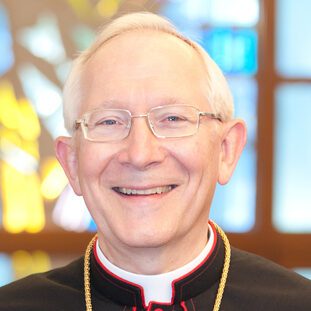
The Most Reverend Leonard P. Blair, S.T.D.
Archbishop Emeritus
Fifth Archbishop of the
Archdiocese of Hartford
The Most Reverend Leonard P. Blair, S.T.D.
The Most Reverend Leonard Paul Blair, born in Detroit on April 12, 1949, was named the Fifth Archbishop of Hartford on October 29, 2013, and installed in the Cathedral of Saint Joseph on December 16, 2013. On May 1, 2024, Pope Francis accepted Archbishop Blair’s resignation.
Archbishop Blair was ordained to the priesthood for the Archdiocese of Detroit on June 26, 1976, following studies at Sacred Heart Seminary College, Detroit; the North American College, Rome; and the Pontifical Gregorian University, Rome. Archbishop Blair holds a Bachelor of Arts (B.A.) in History from Sacred Heart Seminary College; a Bachelor of Sacred Theology (S.T.B.) from the Pontifical Gregorian University; a Licentiate in Theology (S.T.L.) with a specialization in Patristics and the History of Theology from the Pontifical Gregorian University; and a Doctorate in Theology (S.T.D.) from the Pontifical University of St. Thomas Aquinas (Angelicum), Rome.
Archbishop Blair’s parish assignments in the Archdiocese of Detroit were St. Martin de Porres, Warren; Our Lady of Queen of Peace, Harper Woods; St. Christopher, Detroit; and St. Paul, Grosse Pointe Farms, where he served as Pastor at the time of his ordination as a Bishop.
Other assignments included: Instructor in Church History and Patristics, Saint John’s Provincial Seminary, Plymouth; Archivist for the Archdiocese of Detroit; Administrative Secretary to the Archbishop of Detroit; Vicar General and Chancellor of the Archdiocese of Detroit; Consultor; Dean of Studies and Assistant Professor of Theology, Sacred Heart Major Seminary College, Detroit; Ecumenical Officer of the Archdiocese of Detroit. Assignments in Rome were in the Vatican Secretariat of State, and later the Prefecture for the Economic Affairs of the Holy See as Secretary to Edmund Cardinal Szoka.
Over the years Archbishop Blair has served on several committees of the United States Conference of Catholic Bishops, including the Committee on Women in Society & the Church; the Committee on Catechesis; and the Subcommittee on the Catechism, which he chaired. In recent years, he also served as the chair of the Committee on Evangelization & Catechesis and as a member of the Doctrine Committee and the Ad Hoc Committee on Religious Liberty. He currently serves as the chairman of the Committee on Divine Worship.
On May 1, 2024, Archbishop Blair’s resignation was accepted by Pope Francis.
July 9, 1999
Appointment as Titular Bishop of Voncariana and Auxiliary Bishop of Detroit.
August 24, 1999
Episcopal Ordination.
October 7, 2003
Appointment as Bishop of Toledo, Ohio.
December 4, 2003
Installation as the Seventh Bishop of Toledo.
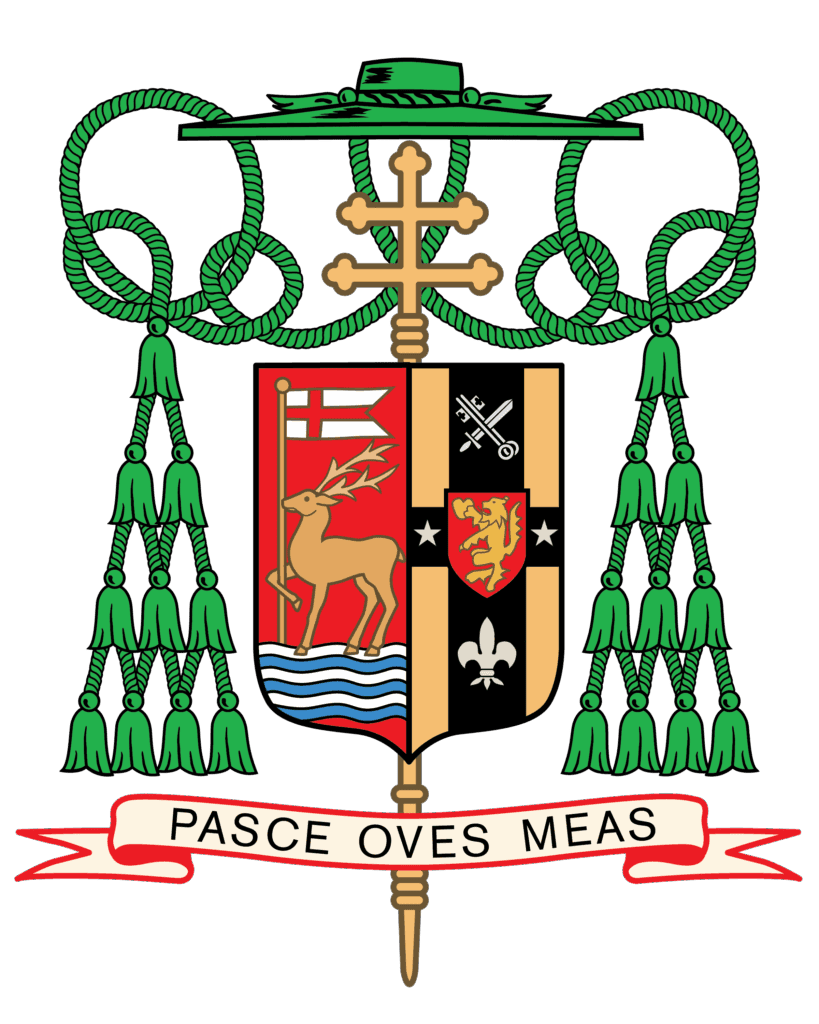
Archbishop Blair’s Coat of Arms
By Deacon Paul J. Sullivan
BLAZON:
Arms impaled. Dexter: Gules, at the nombril point a fess bary wavy of six, Argent and Azure, thereupon a stag Or holding in his forepaw a Paschal Banner Proper. Sinister: Or, a cross throughout Sable thereupon to chief two keys and a sword, per saltire, interlaced, to sinister and dexter a star and in base a fleur-de-lis all Argent; at the center on an escutcheon Gules a lion rampant holding in his forepaw a heart of the first.
SIGNIFICANCE:
The archepiscopal heraldic achievement, or archbishop’s coat of arms, is composed of a shield, which is the central and most important part of the design, a scroll with a motto and the external ornamentation. The design is described (blazoned) as if the description was being given by the bearer (from behind) with the shield being worn on the left arm. Thus, it must be remembered, where it applies, as the device is viewed from the front that the terms sinister and dexter are reversed.
By heraldic tradition, the arms of the bishop of a diocese, called a “diocesan bishop” or in an ecclesiastical province where the bishop of a certain diocese serves as the “first-among-equals” in that province and is called the “Metropolitan Archbishop,” their are joined (impaled) with the arms of their jurisdiction, in this case the Archdiocese of Hartford, that are seen in the dexter impalement (left side) of the design.
The arms of the archdiocese are referred to as “canting,” (armes pariantes) or “playing on” the name of the See City. Here, on a red field is a golden deer, sometimes called a “hart,” that is standing in a river crossing, of silver (white) and blue, known as a “ford.” Thus, the play is on the name deer-crossing or Hartford. The hart is carrying a Paschal banner, that is described as “Proper, meaning “as it always appears” (gold pole with a burgee (notched-end flag) of white, charged with a red cross). Here the stag is carrying the standard of The Faith across the representation of water, that being the Connecticut River that runs through the See City.
For his personal arms, His Excellency, Archbishop Blair continues to use the arms that he adopted upon his being chosen to receive the fullness of Christ’s priesthood when he was called to be an Auxiliary Bishop of Detroit and which he retained during his tenure as Bishop of Toledo.
These arms are composed of a gold (yellow) field on which is displayed a black cross throughout, with two silver (white) stars on the cross members, taken from the arms of the Archdiocese of Detroit. In the base of the cross is a fleur-de-lis, for the Most Blessed Virgin Mary, and in the chief are two keys crossed and interlaced with a sword, for the apostles of Peter and Paul. These two charges are emblematic of the church’s constitution of being Marian and Apostolic.
In the center of the cross is a small shield called an escutcheon. It is red and charged with a gold lion, to cant on the Archbishop’s Baptismal patron, Saint Leonard. The lion holds in his forepaw a heart, to honor the Sacred Heart titular of the major seminary where Archbishop Blair studied and later served on the faculty. The lion also appears in the arms of the Pontifical North American College, in Rome, where the Archbishop did his advanced theological studies.
For his motto, His Excellency Archbishop Blair has retained the phrase “PASCE OVES MEAS.” The phrase, is taken from Saint John;s Gospel (Jn. 21:15ff) which translates “feed” or “tend my sheep.” These are the words that were addressed by Christ to Saint Peter about love and denial and as The Church was entrusted to Saint Peter this phrase becomes the magna carta of pastoral charity and the mission of the church’s pastors.
The achievement is completed by the external ornamentation which are a gold (yellow) archiepiscopal processional cross, (with two cross members) that is placed in back of the shield and which extends above and below the shield, and the pontifical hat, called a “galero,” with its ten tassels in four rows on either side of the shield, all in green. These are the heraldic insignia of a prelate of the rank of archbishop, by instruction of The Holy See, of March 31, 1969.
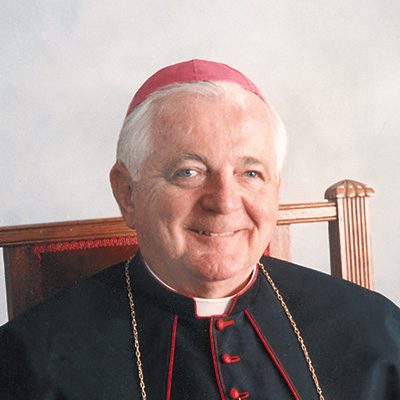
The Most Reverend Daniel A. Cronin, S.T.D.
Archbishop Emeritus
Third Archbishop of Hartford
The Most Reverend Daniel A. Cronin, S.T.D.
Born November 14, 1927, Newton, Massachusetts
Attended St. Peter School, Cambridge; Boston College High School, 1945; St. John Seminary, Brighton, Massachusetts, 1949; North American College, Rome.
Ordained a Priest December 20, 1952 at the Basilica of St. John Lateran, Rome.
Received a Licentiate in Sacred Theology, Gregorian University, Rome, 1953; a Doctorate of Sacred Theology, Gregorian University, Rome, 1956.
Parochial Ministry in Salisbury, Lynn and Waltham, Massachusetts.
Attache, Apostolic Internunciature in Addis Ababa, Ethiopia, 1957.
Attache, Secretariat of State, Vatican City, 1961.
Named Papal Chamberlain, with title of Monsignor, 1962.
Named Titular Bishop of Egnatia and Auxiliary Bishop of Boston, June 10, 1968.
Ordained Bishop, September 12, 1968, Holy Cross Cathedral, Boston, Massachusetts.
Pastor of St. Raphael Parish, Medford, Massachusetts, 1968.
Named Fifth Bishop of Fall River Diocese, October 30, 1970.
Installed December 16, 1970, St. Mary of the Assumption Cathedral, Fall River, Massachusetts.
Named Eleventh Bishop and Third Archbishop of Hartford Archdiocese, December 10, 1991.
Installed January 28, 1992, Cathedral of St. Joseph, Hartford, Connecticut.
Received Pallium from Pope John Paul II on June 29, 1992, St. Peter’s Basilica, Vatican City.
25th Anniversary of Ordination as a Bishop, Cathedral of St. Joseph, Hartford, Connecticut, September 12, 1993.
Recipient of the Father McGivney Award from the Connecticut Knights of Columbus, March 21, 1999.
Past Chairman of the Episcopal Board of Governors of the Pontifical North American College, Rome.
Retired, December 18, 2003.
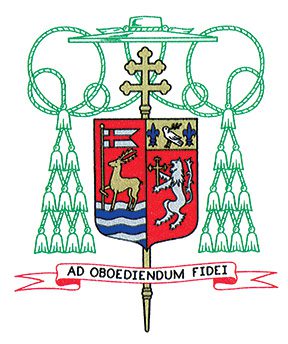
Archbishop Cronin’s Coat of Arms
By Paul J. Sullivan, P. Sullivan & Co., Narragansett, Rhode Island
BLAZON:
Arms impaled. Dexter: Gules, a hart Or, bearing the Paschal banner Proper, the staff paleways of the second, and trippant over a ford barry wavy of six Argent and Azure. Sinister: Gules, a lion rampant Argent, holding in the fore paws a Latin cross fleury Or, on a chief of the same a dove regardant Proper, holding in the beak an olive branch Vert, between two fleur-de-lis Azure.
SIGNIFICANCE:
The archepiscopal heraldic achievement, or as it is more commonly known, the archbishop’s coat of arms, is composed of a shield, with its charges, a motto scroll and the external ornaments. The shield, which is the central and most important feature of any heraldic device, is described (blazoned) in the 12th century terms as if it were being worn on the arm and is being viewed from the rear. Thus, it must be understood that the terms dexter and sinister are reversed as the design is being viewed from the front.
By heraldic tradition, the arms of an archbishop, or bishop of a diocese, are joined (impaled) with the arms of his jurisdiction, seen in the Dexter impalement (left side) of the shield, in this case these are the arms of the Archdiocese of Hartford.
In the sinister impalement (right side) of the device, are the personal arms of Archbishop Cronin, that were adopted at the time of his selection to receive the fullness of Christ’s most holy Priesthood, as Auxiliary Bishop of Boston and which were retained during his tenure as Bishop of Fall River, Massachusetts.
These arms are composed of a red field on which is seen a silver (white) lion rampant, to honor the Archbishop’s baptismal patron, Daniel, the prophet in the Old Testament. The lion holds in his front paws a golden cross fleury which is taken from the arms of the Archdiocese of Boston, where Archbishop Cronin was born, baptized, confirmed and received his episcopal ordination in Holy Cross Cathedral.
The upper portion of these arms, known as a “chief,” is gold (yellow) and displays symbols of the three Popes that the Archbishop served during his time as Secretary to the Apostolic Internunciature in Ethiopia and in the Secretariat of State at the Vatican. The dove holding the olive branch is from the arms of Pope Pius XII and the fleur-de-lis are from the arms of Pope John XXIII and Pope Paul VI.
For his motto, His Excellency employs the phrase “AD OBOEDIENDUM FIDEI,” which is Latin and is taken from Saint Paul’s Epistle to the Romans (1:5). Its translation, “For obedience of Faith,” expresses the Archbishop’s belief that each of us is necessarily bound to be obedient to Christ, His teachings and His Church, by virtue of our Faith in Him.
The device is completed with the external ornaments which are a gold archepiscopal (two cross members) processional cross, which is placed in back of the shield and which extends above and below the shield, and a pontifical hat, called a gallero, with its ten tassels, in four rows, on either side of the shield, all in green. These are the heraldic insignia of a prelate of the rank of archbishop, by instruction of The Holy See of March 31, 1969.
The Most Reverend Christie Macaluso, D.D.
Auxiliary Bishop Emeritus
The Most Reverend Christie Macaluso, D.D.
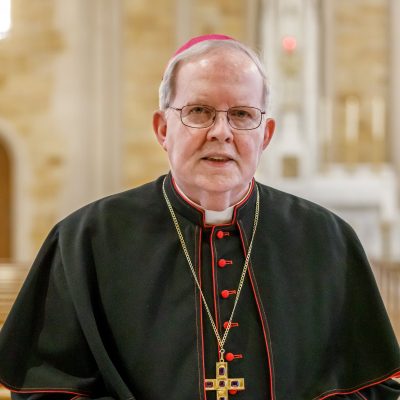
Bishop Christie Macaluso, born in Hartford on June 12, 1945, served his native archdiocese as the Eighth Auxiliary Bishop from 1997 until his retirement in 2017. He held several administrative positions, and in the course of his priestly and episcopal ministry, he earned Masters degrees in three fields – sacred theology, philosophy and psychology; studied six languages – Latin, Greek, Hebrew, French, German and Dutch; and enjoyed music studies in violin, piano, organ, theory, composition and conducting.
Baccalaureate degree in philosophy, St. Mary’s Seminary, Baltimore, Maryland.
Master of Sacred Theology degree, St. Mary’s Seminary, Baltimore, Maryland.
Master of Arts degree in philosophy, Trinity College, Hartford.
Master of Arts degree in psychology, New York University.
Ordained a Priest by Archbishop Whealon, May 22, 1971.
Served as assistant pastor, St. Thomas the Apostle Parish, West Hartford and St. Joseph Parish, New Britain.
Faculty member of St. Thomas Seminary College as an instructor in philosophy.
Appointed academic dean of St. Thomas Seminary in 1980 and rector and president in 1985. While on the seminary staff, he served as a weekend assistant at St. Francis Parish in Torrington and Sacred Heart Parish in Bloomfield.
Served as Pastor of Cathedral of St. Joseph from June 1991 through June 1997.
Named by Pope John Paul II as a prelate of honor with the title of monsignor and named Episcopal Vicar for Hartford, 1995.
Has worked with the Greater Hartford Consortium on Higher Education, the Asylum Hill Organizing Project and the Christian Conference of Connecticut.
Episcopal Ordination as Titular Bishop of Grass Valley and the eighth Auxiliary Bishop of the Archdiocese of Hartford, June 10, 1997.
Served as Vicar General and Moderator of the Curia until May 2014.
Appointed rector of St. Thomas Seminary in 2014.
On December 15, 2017, Pope Francis accepted the resignation of Bishop Macaluso.
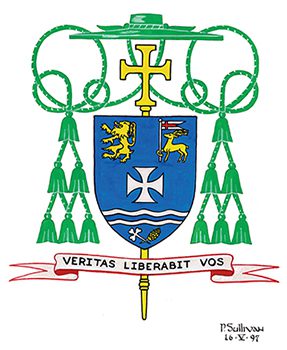
Bishop Macaluso’s Coat of Arms
By: Paul J. Sullivan, Narragansett, Rhode Island
For his personal arms Bishop Macaluso has selected a design that reflects his life as a priest and as a Bishop. The entire design is placed on a blue shield, reflecting his devotion to the Blessed Mother.
In the main portion of the design there are three symbols that are of particular importance to the Bishop. The most central is the cross of our faith, represented in what is called “a cross formy.” This format of the cross is the type that was used on the invitation and prayer cards that were used for the priestly ordination of Bishop Macaluso, and so it is particularly appropriate as he receives the fullness of Christ’s priesthood as a bishop.
This cross is placed below two other charges that have come to make Bishop Macaluso the person that he is. These are the gold lion of Saint Thomas Seminary, where the Bishop served as Rector, and the gold “hart,” holding the silver banner of Christ, for which the city and the See of Hartford are named and which Bishop Macaluso has served for all of his priestly ministry.
The silver wavy barlets, that signify the water at the “ford” of Hartford, recognize the impact that water has had on the Bishop’s life and on his heritage. By means of water we enter the Body of Christ in Baptism. Water is also very much a part of the lives of those who live, work and recreate in the Archdiocese of Hartford, located on the Connecticut River and abutting Long Island Sound.
In the base of the shield are crossed a silver shamrock and a golden pine cone. These honor the Irish heritage that His Excellency has received from his mother, Helen Meaney Macaluso, and the Italian heritage that he has received from his father, Albert Carl Macaluso. While the use of the shamrock is rather straightforward, it must be understood that on the Palermo side of Sicily, especially in the mountain regions, the pine cone, because it is so rare, is a prize. Used in special cooking the pine cone has become a symbol of special honor for the people of this region to which Bishop Macaluso traces his heritage.
For his motto, Bishop Macaluso has selected the Latin phrase, “VERITAS LIBERABIT VOS.” This phrase, taken from the Gospel of St. John (John 8:32), is translated to express the deepest of Christian beliefs that “the truth will set you free.” For it is in believing, and in making those beliefs part of our lives, that we become free from the evils that surround us and try to ensnare us each day, as we move to the blessed eternity that Christ won for us by his death on the cross.
Completing the external ornaments are a gold processional cross in back of the shield which extends above and below the shield, with the pontifical hat, called a “gallero,” with its six tassels in three rows on either side of the shield, all in green. These are the heraldic insignia of a prelate of the rank of bishop by instruction of the Holy See of March 31, 1969.
The Most Reverend Peter A. Rosazza, D.D.
Auxiliary Bishop Emeritus
The Most Reverend Peter A. Rosazza, D.D.
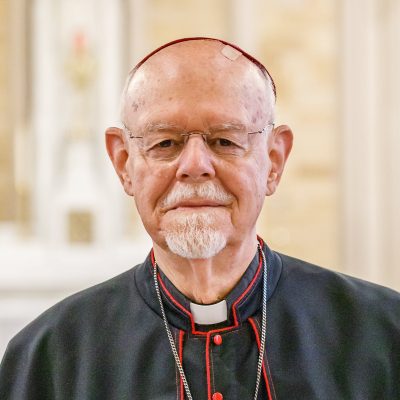
Born in New Haven, Connecticut on February 13, 1935, Bishop Rosazza is the eldest child of the late Agatha (Dinneen) and Aldo Rosazza. He grew up in Torrington and attended St. Francis Elementary School and Torrington High School graduating in 1952. After one year at Dartmouth College he entered St. Thomas Seminary in Bloomfield, Connecticut. Next he studied at St. Bernard Seminary in Rochester, New York, and completed his four-year concentration in theology at Seminare Saint-Sulpice in Paris, France. He was ordained a priest for the Archdiocese of Hartford in Notre Dame Cathedral in Paris on June 29, 1961.
Back in Connecticut he served as assistant pastor in the Church of St. Timothy in West Hartford and then was appointed to the faculty of St. Thomas Seminary where he taught French, Spanish and Italian.
In 1972 he became co-pastor of Sacred Heart Church in Hartford’s north end, the mother church of Hartford’s Hispanic Catholic community. In 1978 he was named auxiliary bishop to the Archbishop of Hartford by Pope Paul VI and was ordained bishop on June 24. He continued to minister at Sacred Heart until his transfer to Waterbury in 1981. In 1988 he was assigned to New Haven.
On February 2, 1997, Archbishop Cronin appointed him Episcopal Vicar for the Spanish speaking Catholics in the Archdiocese of Hartford.
He is a member of the National Conference of Catholic Bishops’ Committee for Social Development and World Peace and is liaison with Brazilian Catholics for the Committee on Migration and Refugees. He is also bishop advisor to the National Catholic Student Coalition. He is one of the founders of the Naugatuck Valley Project, a coalition of churches and labor union locals as well as ECCO (Elm City Congregations Organized), a community organization of 18 churches in the New Haven area. Also, he is one of the five bishops who drafted the U.S. Catholic Bishops’ Pastoral Letter on the U.S. Economy and Catholic Social Teaching.
Pope Benedict XVI accepted Bishop Rosazza’s resignation on June 30, 2010, after the Bishop submitted the customary letter of resignation on his 75th birthday, February 13, 2010.
Most Reverend Peter A. Rosazza, D.D.
Office of the Auxiliary Bishop Emeritus
467 Bloomfield Avenue
Bloomfield, CT 06002-2999
860-761-7430