
Archdiocesan Employee Venerates Mortal Remains of St. Francis of Assisi
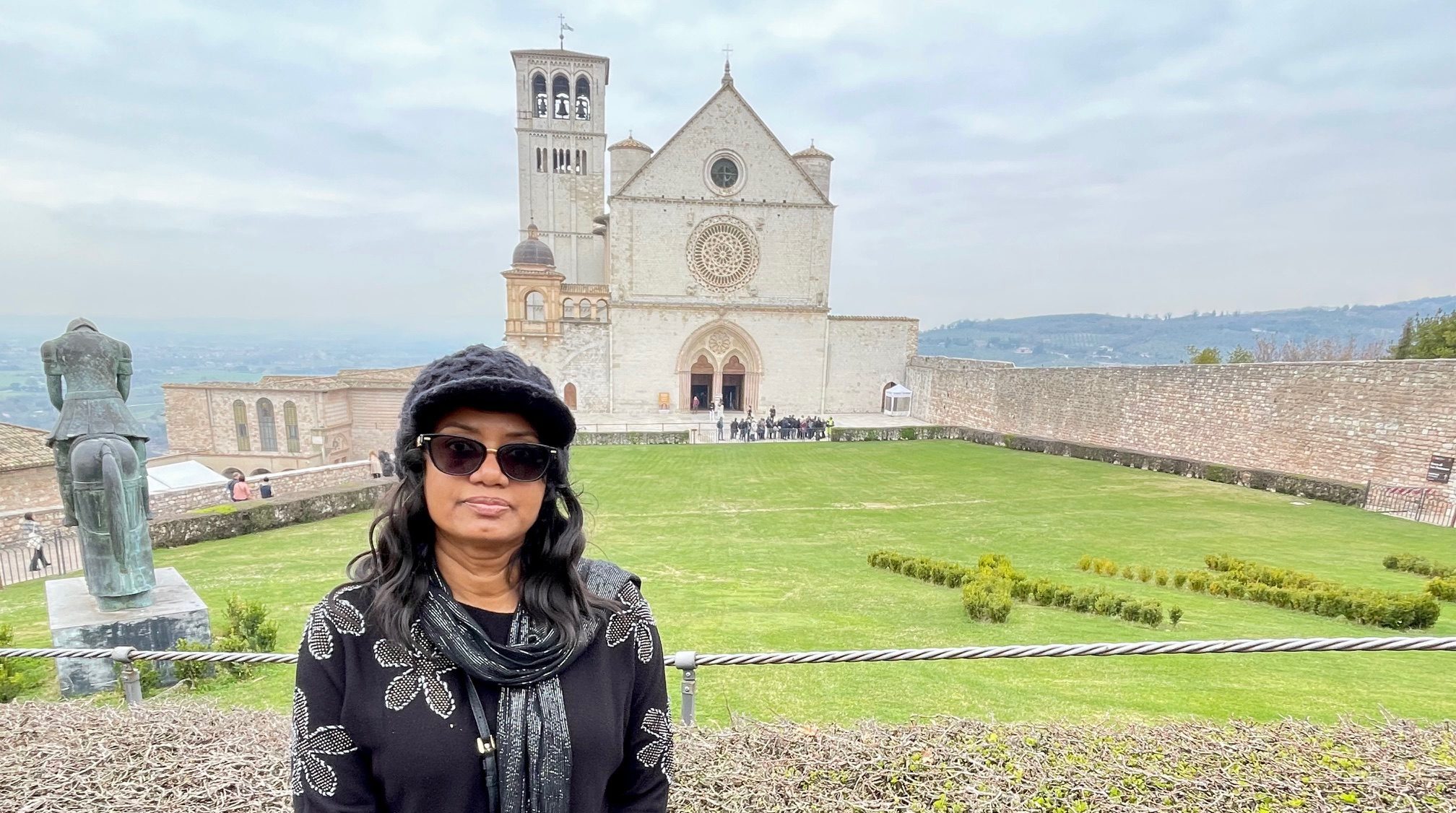
Story by Shelley Wolf
Fulfilling a dream, an employee of the Archdiocese of Hartford got the rare opportunity to get a little closer to St. Francis of Assisi.
Meriline Sarkar participated in a rare exposition of the body of St. Francis, whose mortal remains were made visible for veneration for only one month (Feb. 22 to March 22) in Assisi, Italy, to commemorate the 800th anniversary of his death.
“I thought, ‘I cannot miss this opportunity,’” says Sarkar, an administrative assistant for the Archdiocese of Hartford’s Metropolitan Tribunal, who saw the event advertised online in the fall of 2025.
St. Francis of Assisi’s relics have been viewed by the public only once in 800 years. The recent viewing attracted 370,000 pilgrims, who had to register online for their visit.
“St. Francis of Assisi is just so inspiring,” says Sarkar, who admires the saint for his humility and Gospel-inspired way of living. “I wanted to see him. I felt a pull. I couldn’t stop myself, even though I didn’t have the money for the trip.”
In the interim, she landed a new job with paid vacation time, which made the pilgrimage possible. “It’s like God lined it up,” she says with gratitude. Sarkar, now a U.S. citizen, traveled to Rome alone, then joined five priests from her homeland of Bangladesh for the final leg to Assisi.
The Basilica of St. Francis, which houses the saint’s remains, was built in Assisi in the saint’s honor in 1230. Now a papal basilica, the care of the saint’s remains are overseen by the Order of Friars Minor Conventual (Franciscan Conventuals).
Waiting outside to get in, she says, “I waited anxiously praying. Then we were led inside by a monk and shown the church.”
The pilgrims were led to a glass container, where St. Francis’ bones were laid. “I touched the case and started crying,” Sarkar says, as she prayed to the saint. “It was overwhelming. He has always been my favorite, with his humble story.”
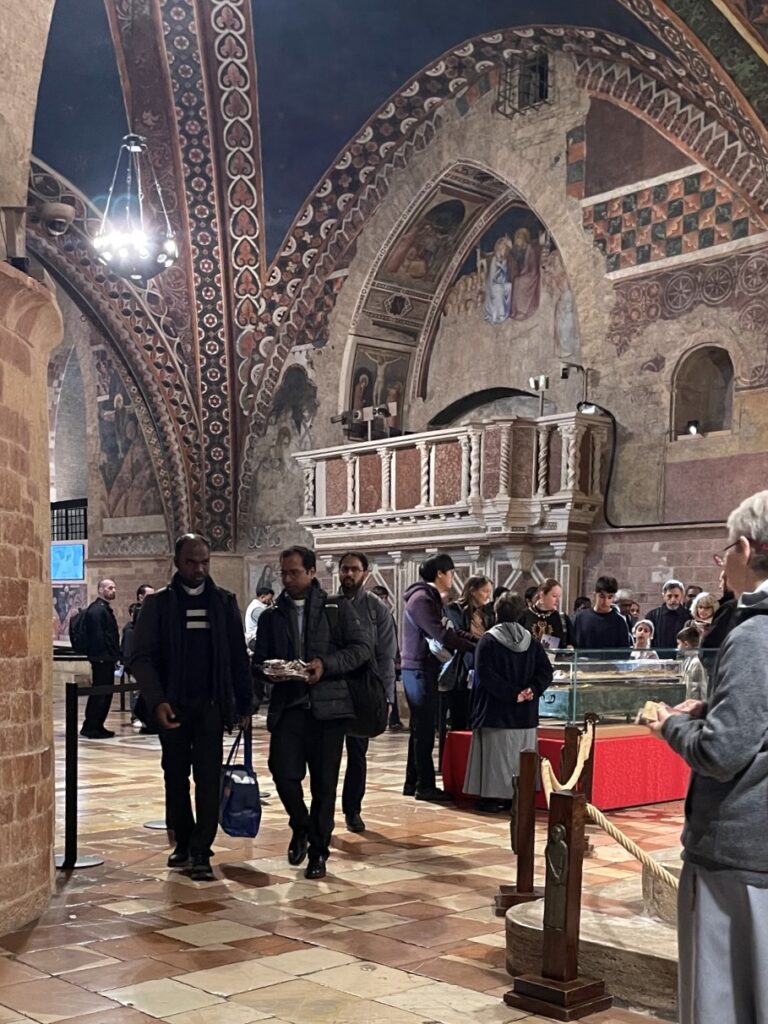
Sarkar also saw the famous San Damiano crucifix, from which St. Francis heard a voice commanding him to “repair my house.” “I saw the cross he used to kneel before and pray to. That cross is still hanging,” she reports.
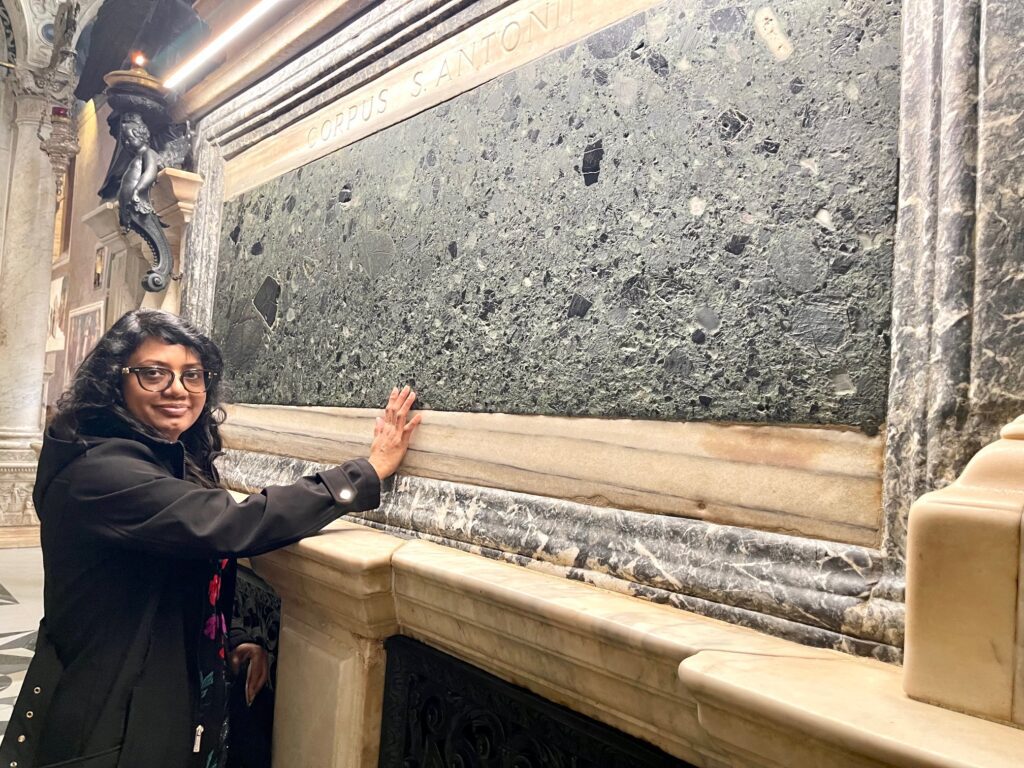
Sarkar enjoyed the small town of Assisi. “It’s so beautiful. It’s a Medieval town and still has cobblestone streets. You need great endurance to walk up and down,” she says.
While in Assisi, she also prayed at the tombs of St. Clare, one of the first followers of St. Francis, and St. Carlo Acutis, the first millennial saint.
Then there was the site of St. Francis’ father’s house, which is topped by a church. “There’s a statue of his parents holding a piece of garment,” she says, referring to the garments St. Francis rejected, along with his father’s worldly textile trade, for a life devoted to Christ and lived in poverty, humility and fraternity.
St. Francis, a lover of peace, the poor, and the natural world, founded the Franciscan orders and later received the stigmata of Christ.
Though his remains are no longer on view, visitors are still welcome to visit the Basilica of St. Francis and to pray at his tomb. For more information, visit sanfrancescovive.org/en/home.