

One of the ways to move from analysis to action is to use the ART process: Act, Reflect, Transform. In Activity One you used the seven principles of Catholic social teaching analyze a social issue (the reflect part of the ART process).
In part one of this activity you will move from analysis to action—charitable works (or service) and social justice. You can use the processes of Activity One and Two with the children, youth, and/or adults that you teach and work with. The process and worksheet is in the Catholic Social Teaching Guide (pages 18 – 20) or you can download it in either Word (editable) or PDF (printable) formats.
Part One: The ART of Catholic Social Teaching: Act – Reflect – Transform
The goal of the ART process is to infuse the values and work of the building God’s Reign of justice and peace into our lives and world.
Act in charity to meet immediate and urgent needs. Act to alleviate the symptoms of social problems, such as feed the hungry, shelter the homeless, resettle refugees, protect victims of domestic violence, collect recyclables. Perform the Corporal Works of Mercy: feed the hungry, give drink to the thirsty, clothe the naked, shelter the homeless, visit the imprisoned, visit the sick, bury the dead.
Charity…
- focuses on the needs of individuals, families, and creation
- looks at individual situations of need
- meets immediate and urgent needs
- addresses painful individual symptoms of social problems
Reflect on the root causes and Catholic social teaching.
- Ask Why? Why are people hungry, homeless, uprooted, battered or discriminated against? Why is our ecosystem deteriorating?
- Listen to those who are most directly affected: the poor and the marginalized.
- Ask deeper questions that challenge the status quo.
- Explore the underlying causes poverty, violence, homelessness, racism, ecological devastation, and other issues.
- What does Scripture and Catholic social teaching say about these social issues and their causes?
Transform in justice the root social causes and social structures that contribute to suffering and injustice. Social transformation is a different kind of action. Transformation gets at root causes; it does not stop at alleviating symptoms. We can transform our communities and our world through advocating for just laws and public policies, working with organized low-income people, patronizing or boycotting businesses based on social values, living simply and ecologically, investing in socially responsible ways, creating new social structures (e.g., low-income housing).
Justice…
- focuses on the rights of individuals, families, and creation.
- analyzes social situations or social structures.
- works for long-term social change.
- addresses the underlying social causes of problems.
- relies on just laws and fair social structures.
(Excerpted from: Leader’s Guide to Sharing Catholic Social Teaching. USCCB, 2000)
Part Two: Developing an Action Plan for You Social Issue
Use the image of the “Two Feet of Love in Action” to develop action strategies for the issue you selected in Activity One. The article and worksheet are in the Downloadable Guide.
- Watch the video: “Two Feet of Love in Action” from the Catholic Campaign for Human Development (video, 2:45 minutes)
- Develop ideas for Social Justice and Service (charitable works) to address your social issue (see the graphic below). Download the Worksheet of the “two feet” to assist you.
After you have completed the activity, reflect on what you have learned through this module about Catholic social teaching and how it applies to life today, and how social justice and service (charitable works) are essential for addressing social issues. Think about how you can use this process with the children, adolescents, and/or adults with whom you work.
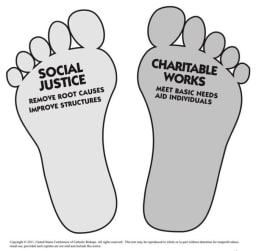
Service
- Focuses on the needs of people
- Looks at individual situations
- Meets immediate needs
- Ameliorates symptoms of social problems
- Relies on generosity of donors
Justice
- Focuses on the rights of people
- Analyzes social situations or structures
- Works for long-term social change
- Addresses underlying social causes
- Relies on just laws and fair social structures