

Sacred Sounds: Jeffrey Parola
November 13 @ 7:00 pm
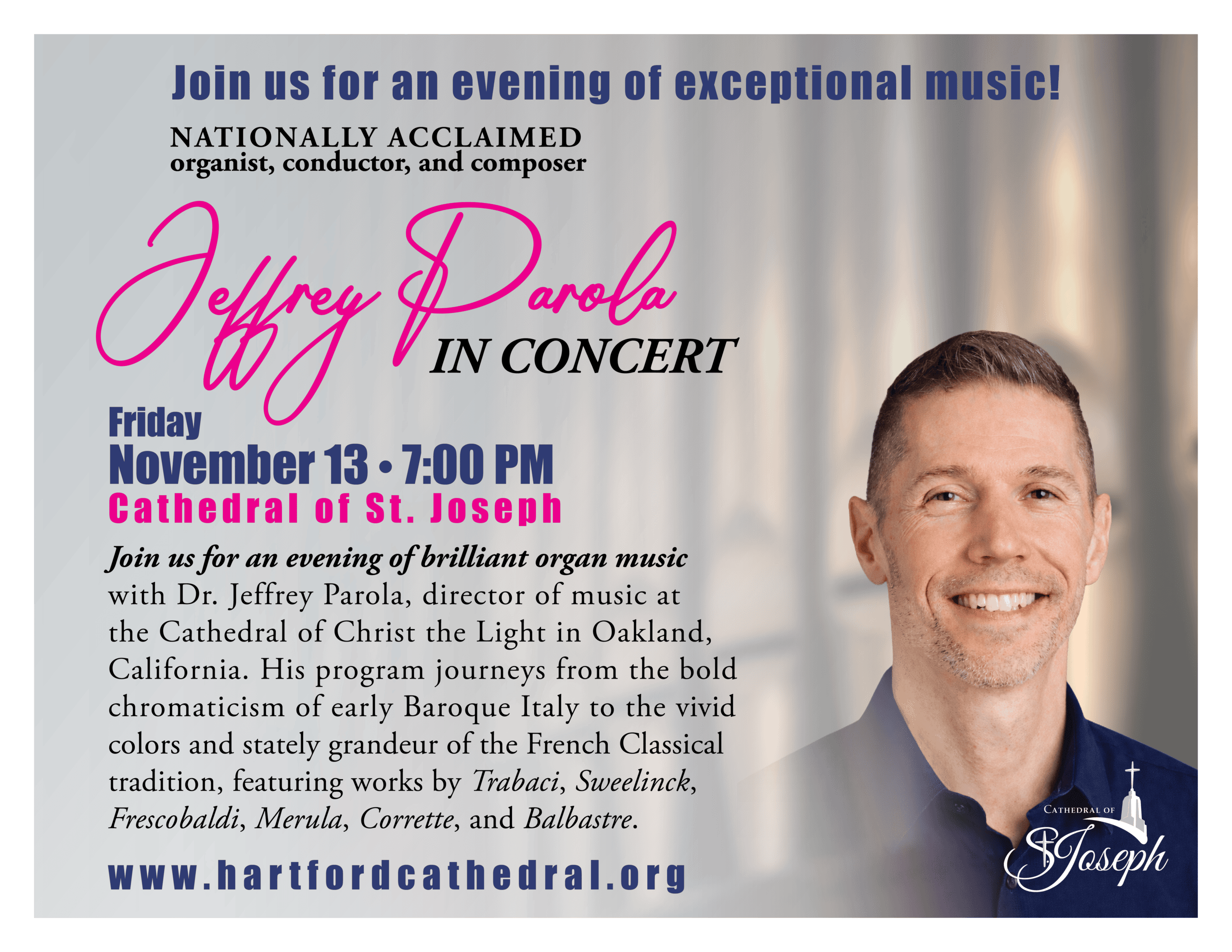
Join us for an evening of brilliant organ music with Dr. Jeffrey Parola, director of music at the Cathedral of Christ the Light in Oakland, California. His program journeys from the bold chromaticism of early Baroque Italy to the vivid colors and stately grandeur of the French Classical tradition, featuring works by Trabaci, Sweelinck, Frescobaldi, Merula, Corrette, and Balbastre.
Friday, November 13, at 7:00 p.m.
Cathedral of Saint Joseph
BIO
Dr. Jeffrey Parola is an organist, conductor, composer, and liturgical musician whose three-decade career reflects a sustained commitment to the organ and the traditions of sacred music. He serves as Director of Music at the Cathedral of Christ the Light in Oakland, California, where he leads the Cathedral Choir and oversees a music program distinguished by its artistic excellence, reverent liturgy, and dedication to the Church’s rich musical heritage. Through its liturgical celebrations and concert offerings, the Cathedral has earned national recognition for its commitment to sacred music and the presentation of great works of the musical tradition. Parola previously served as Director of Music at St. Paul the Apostle Catholic Church in Los Angeles and as Master of the Music at St. Thomas the Apostle Church in Hollywood.
In addition to his work as an organist and church musician, Parola has pursued a career in composition and higher education. His compositions for orchestra, chamber ensembles, and chorus have been commissioned and performed internationally. His honors include the Rappaport Prize for Music Composition, the Hoefer Prize, and the Charles Ives Scholarship from the American Academy of Arts and Letters. He has also taught at the Colburn School and the University of Southern California.
PROGRAM – Italian Early Baroque Chromaticism and the French Classical Tradition
I. Italian Early Baroque Chromaticism
Toccata Terza & Ricercar sopra il Cimbalo Cromatico
Giovanni Maria Trabaci (c. 1575–1647)
Fantasia Chromatica
Jan Pieterszoon Sweelinck (1562–1621)
Toccata Cromatica per l’Elevazione
Girolamo Frescobaldi (1583–1643)
Capriccio cromatico
Tarquinio Merula (c. 1595–1665)
II. The French Classical Tradition
Suite de 2e Ton
Michel Corrette (1707–1795)
I. Plein jeu
II. Duo en Rondeau
III. Trio pour les Flûtes
IV. Basse de Trompette
V. Duo sur les Flûtes
VI. Récit de Trompette ou de Haut-bois
VII. Trio
VIII. Andante
IX. Fugue en toutes blanches
X. Grand jeu
XI. Grand jeu avec la Tonnerre
Concerto in D major
Claude Balbastre (1724–1799)
I. Prélude
II. Allegro
III. Gavotte
IV. Allegro
Prélude et fugue en ré mineur
Claude Balbastre
I. Prélude
II. Fugue
NOTES
I. Italian Early Baroque Chromaticism
In the early seventeenth century, Italian composers explored the expressive power of chromaticism through unexpected harmonies, bold dissonances, and inventive counterpoint.
Giovanni Maria Trabaci’s Toccata Terza & Ricercar sopra il Cimbalo Cromaticoexemplifies the virtuosic freedom of the Italian keyboard tradition, venturing into the unusual tonal territory suggested by its reference to the chromatic keyboard. Girolamo Frescobaldi’s Toccata Cromatica per l’Elevazione, intended for the solemn moment of the Elevation at Mass, turns chromaticism toward an intensely contemplative expression. Tarquinio Merula’s Capriccio cromatico brings a spirit of experimentation to this adventurous harmonic language, with ascending and descending chromatic scales relentlessly permeating the entire work. Together, these works illuminate the distinctive expressive imagination of the Italian early Baroque.
II. The French Classical Tradition
The French Classical organ tradition offers a strikingly different approach to musical color. Rather than emphasizing chromatic tension, French composers developed an elegant and highly distinctive musical language shaped by the varied timbres of the organ, the rhythms of the dance, and the grandeur of French ceremonial life.
Michel Corrette’s Suite de 2e Ton draws on the established forms and tonal conventions of French liturgical organ music. Claude Balbastre’s Concerto in D, by contrast, reflects the brilliance and theatrical flair of the eighteenth-century French organist. Balbastre’s Prélude et fugue en ré mineur brings the program full circle, with a chromatic, harmonically adventurous prelude recalling the expressive daring of the first half, followed by a fugue that showcases the contrapuntal mastery of the French Classical tradition.