Skip to content

Bloomfield Church Remodel Blends Beauty and Purpose

Story by Shelley Wolf

Elevated on plywood, the sanctuary floor was sagging. The vinyl flooring in the nave had cracked. Over time, a church’s structure and beauty show evidence of decades of service and wear.

But after undergoing an interior renovation last fall, Sacred Heart Church in Bloomfield has a new look. Dedicated in 1963, the contemporary-style church has been refreshed with new flooring, an elevated altar, a cleaned-up choir loft and the introduction of old and new artwork.

“It looks beautiful, it’s theologically ordered, and it sounds great,” says Father Ruminski, who commissioned the work on behalf of the parish. “It’s beauty and purpose coming together. I think we accomplished a lot in the renovation to communicate all those things.”

As the former pastor of Sacred Heart Parish, Father Ruminski is happy to reflect on last fall’s remodel of Sacred Heart Church. However, just this month, he was reassigned to St. Thomas and St. Timothy Parish in West Hartford.

In the meantime, Father Stuart Pinette, the new pastor of Sacred Heart Parish, can look forward to celebrating Mass in a refurbished worship space.

According to Father Ruminski, the Sacred Heart renovation, which took several months to complete, tackled vinyl floors with asbestos, tightly spaced pews, a crowded and cluttered sanctuary, and a dimly lit interior.

The solution? “It became clear the floor was the obstacle to everything,” Father Ruminski says. After talking to his contractors, the Sullivan Brothers, the solution was to “pull everything out and rethink the floor plan.”

The contractors removed the old vinyl tiles, remediated the asbestos and added brighter gray and cream ceramic tiles throughout the church. They also built a smaller sanctuary floor to better fit the space, then elevated the altar and centered the tabernacle.

With a smaller sanctuary, the original pews could then be respaced with an extra seven inches per row to give parishioners room to maneuver. “It feels more open with the same amount of seating,” Father Ruminski notes. New seat cushions added comfort and improved the acoustics.

In the choir loft, organ pipes were repositioned on either side of a window, allowing the light in. This change also created more room in the loft, enabling the choir to relocate from the sanctuary to the loft.

On the main floor, a vintage copper baptismal font replaced the old leaky one. Originally used in Bloomfield’s Christ the King Church, which closed in 1996, the copper baptismal font was found dented and patinaed in Sacred Heart’s basement. Refurbished, the font is now positioned at the head of the main aisle of Sacred Heart.

To add more beauty, the priest commissioned New Hampshire artist Eileen Cunis to create fabric tapestries for the sanctuary walls. They include four angels and two saints, Blessed Michael J. McGivney, who is on his way to sainthood, and St. Margaret Mary Alacoque, promoter of the Sacred Heart of Jesus, whose relic is embedded in the altar at Sacred Heart Church.

The altar and tabernacle are now the focus. Statues of Mary and Jesus, once hidden in the back of the church, are now visible in side alcoves.

“The overall effect of the renovation is to give the church a much stronger sense of direction,” Father Ruminski says, “that we’re oriented, that we have somewhere to go. And that is in union with God, and in communion with Christ.”
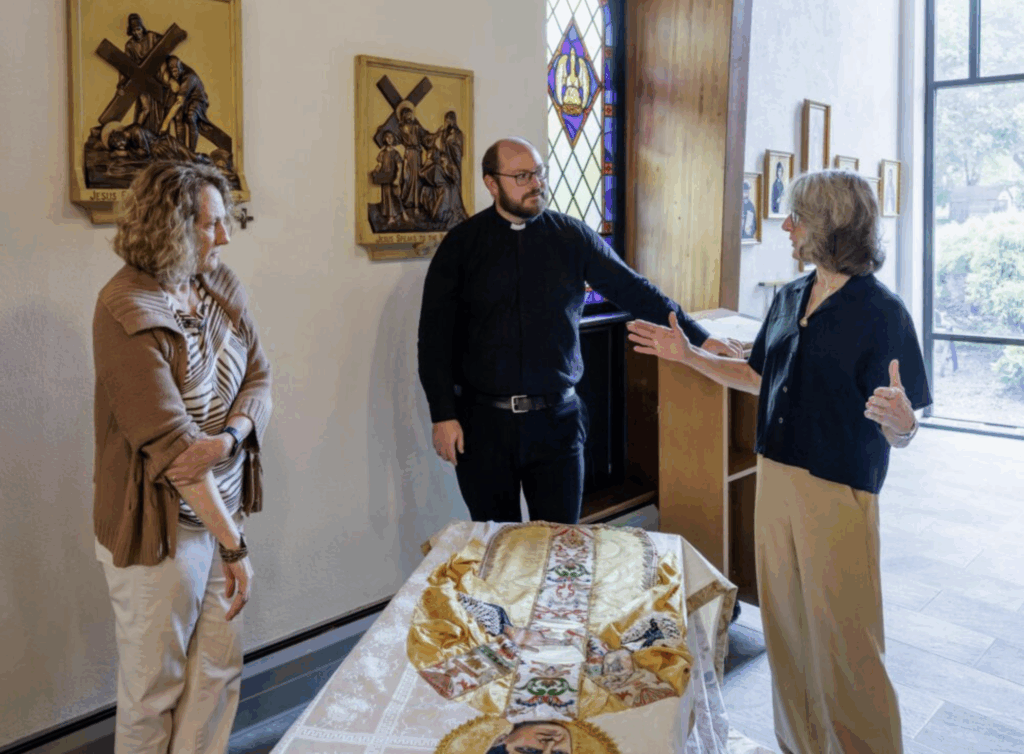
New Hampshire artist Eileen Cunis, far right, delivers one of her tapestries to Father Michael Ruminski and Mary Swetcky, parish secretary.

Public Invited to Venerate Relics of St. Pio in East Haven 

Story by Joe Pisani

For five years, Richard Ruyack Jr., a retired police lieutenant from Yonkers, has taken the relics of St. Padre Pio all over the world for thousands to venerate. 

This year, he has already been to Montreal and Ireland, and on July 26, the first-and-second class relics of St. Padre Pio will be at St. Vincent de Paul Church in East Haven for a day of veneration and Mass.

Ruyack, supervisor of tours for the St. Pio Foundation of Tuckahoe, N.Y., says the relics he will bring for veneration are crusts of St. Pio’s wounds, a handkerchief used during Mass to wipe his tears, a lock of hair, a piece of his mantle and his white glove.

Over the years, he has witnessed healings, favors and “moral miracles” through the saint’s intercession.

“I remember a disabled young girl, who came up with her mother, and she felt there had been a healing,” he recalls. “Another woman said she saw Padre Pio’s face behind the altar.”

Father Thomas J. Walsh, pastor of St. Pio of Pietrelcina Parish which includes St. Vincent de Paul Church, says, “Padre Pio was one of those recognized as saintly by the people before the official canonization process, and once he was canonized, he became very popular. 

He reminds people of St. Francis of Assisi, the founder of his religious order. Both were stigmatics and mystics, and Padre Pio had a great intimacy with our Lord in prayer and was recognized for his miraculous attributes, including being able to read people’s souls when they went to confession.”

Considered one of the Church’s notable saints, St. Pio was born May 25, 1887, in Pietrelcina in Southern Italy, and at age 15 he entered the novitiate of the Capuchin friars. Despite his weak health, St. Pio studied hard and in 1910 was ordained a priest. 

From 1916 until his death in 1968, he lived in the Capuchin monastery in San Giovanni Rotondo. Countless faithful went to him for confession and to receive spiritual guidance.

St. Pio’s life was characterized by suffering, both physical and spiritual, and on Sept. 20, 1918, the five wounds of Christ’s Passion appeared on his body. 

He was declared venerable by Pope John Paul II on Dec. 18, 1997, and canonized on June 16, 2002, when the pope proclaimed him “St. Pio of Pietrelcina” to 500,000 people who attended the ceremony.

Sally Mucka, director of Adult Faith Formation for St. Pio of Pietrelcina Parish, who organized the event with Jennie Llanos, hopes the relics will help people get in touch with the Holy Spirit. 

“I am really excited,” she says. “I still remember the first time St. Pio’s glove came to the church. It was so moving and touching that I was filled with the Spirit. Today, the Holy Spirit is moving in a special way. People are searching, especially young people and I believe this will bring them in so they can decide how to connect with God.”

Father Walsh says he is optimistic that “Padre Pio can call people again to an appreciation of the mysteries of our faith.”

(The relics of St. Padre Pio will be on display at St. Vincent de Paul Church, 80 Taylor Ave., East Haven, on July 26. Veneration will take place from 11 a.m. to 7:30 p.m., with Mass in honor of St. Pio at 5:30 p.m. By touching an item, such as a rosary or a medal, to a first- or second-class relic, it becomes a third-class relic, which can be venerated and used for personal devotion. For additional information, contact the parish office, 203.469.0764 ext. 8 or email saintpio.rcia@gmail.com.)

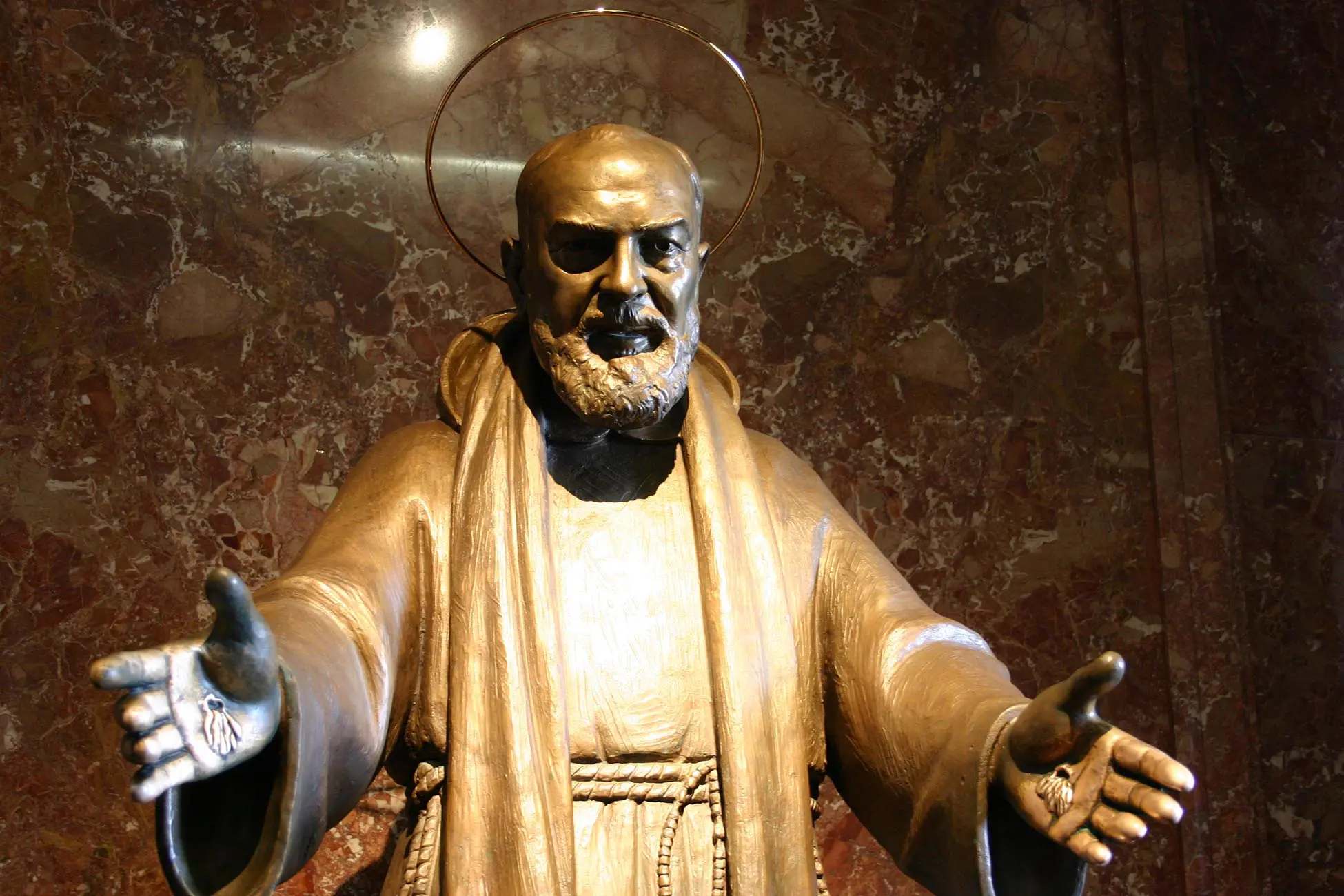
St. Pio of Pietrelcina, commonly known as Padre Pio, was marked by stigmata resembling the wounds of the crucified Jesus Christ.
ADOBE STOCK

Archdiocese Is Selected for National Parent and Family Faith Project

Story by Shelley Wolf

There is a map of the United States with 20 Catholic dioceses that are part of a cutting-edge, family faith project – and the Archdiocese of Hartford is literally on the map.

Hartford appears proudly among the dioceses of New York, Chicago, Los Angeles and Honolulu on a map created by the National Community of Catechetical Leaders, or NCCL, a national association of Catholic religious educators.

“It’s kind of amazing to have Hartford be part of this huge national project that literally goes from coast to coast,” says Kelly Henderschedt, director of Faith Formation and Parish Life for the Archdiocese of Hartford.

The project, “Parents and Families at the Center of Faith Formation,” is being conducted by NCCL thanks to a five-year grant from the Lilly Endowment, a private foundation. The Archdiocese of Hartford is among 20 dioceses invited to participate in the national project, which is helping 200 Catholic parishes across the country engage 30,000 parents and their families.

The project is already underway in the archdiocese in 10 participating parishes.

The 10 parishes include: Most Holy Trinity, Wallingford; St. Peter Claver, West Hartford; St. Margaret, Madison; St. Thomas the Apostle, Oxford; St. Luke, Southington; St. Anthony, Prospect; St. Mary, Simsbury; St. Damien of Molokai, Windsor; St. John Bosco, Branford; and St. Paul VI, Hamden.

Together, the parishes are exploring how to strengthen faith formation at home during the first two decades of life, and create parish communities that support parents and the whole family. All initiatives are incorporating the most current thinking about faith transmission in today’s families.

According to Henderschedt, this is year two of the five-year project, which began in the fall of 2024. The first year involved information gathering. Year two includes idea generation, program development and the launch of pilot programs in the parishes. More activities will be phased in over the following years, ending with evaluation in 2028.

In each of the 10 archdiocesan parishes, parish teams have already completed parent surveys.

“We’re saying, ‘Tell us. What is your biggest struggle with your family? How can we help you grow your child in his or her faith? How can we support you?’” Henderschedt asks. Parents, she says, were thrilled to be asked.

Some parents, she reports, want help talking to their teenagers about faith, some want advice on teaching the Bible at home, and others need help with difficult conversations.

Currently, the parish teams are using the parent data to develop new pilot programs, or tweak existing ones, to better support families in instilling Catholic faith and values. These customized family faith programs are also taking into account various cultures, family structures, caregivers, and the needs expressed by today’s parents.

“In my 25 years of doing faith formation, including my eight years at the archdiocese, I have not seen anything this forward thinking,” Henderschedt says.

“It’s super exciting. It’s so innovative. We’re really thinking outside of the box about how we are forming families. Really creative work is coming out of this,” she insists. Stay tuned for new and engaging family faith programs in the 10 parishes, beginning this fall.

Talk is Cheap, Except Talk About God

Story by Joe Pisani

I have this problem. Most of my family members and friends want to talk about politics —  I should say “argue” about politics — but I prefer to talk about God.

Don’t get me wrong. I know politics is a popular topic, especially for people who love to debate, but to my thinking, there more important things in life, namely God.

I don’t necessarily mean talking about God in a deep theological sense, the way you might in a class with Dr. Scott Hahn, but by sharing personal stories about how God has touched your life, such as those mystical occasions when it was undeniable He intervened to direct you, to protect you, and to share his love and joy.

We all have them; however, some of us don’t look closely enough to realize God is touching us. And most of us are too distracted by the inconsequential to appreciate the miracles that surround us.

Not to be rude, but I really don’t want to hear about your new car, your old car, your political views, your views on face masks, your vacation plans or how you’re going to spend your income tax refund. Although to be polite, I’ll listen.

I’m not insensitive. I’ve just reached the age when — to quote a priest I knew —  “The most important thing is to keep the most important thing as the most important thing.” And the most important thing is God.

Actor Denzel Washington gave a commencement address at Dillard University several years ago and told the young graduates the best advice I ever heard at a graduation. It was the true secret to success in life: “Put God first. Put God first in everything you do.”

Everyone has a story about what happens when we put God first. At least everyone should have a story, countless stories in fact. We just have to be aware of how God is at work in our lives because God is always at work in our lives, and not just in times of crisis.

One woman told me about how God carried her through a cancer diagnosis. When you get news like that, and we all do, you have to stay close to God.

Another told me about how God was there in her grief, when her son was killed by a drunken driver while he walking across a street in Manhattan. Another spoke of how, even in a troubled marriage, her prayers were answered at a time when most people would think God had abandoned them.

I’ve also heard stories of women who entered the religious life because Jesus spoke to them during Eucharistic Adoration. It happens more often than you’d think.

And there are stories about heavenly messengers, who guided people during a time of crisis or at a point in their lives when they thought they couldn’t go on. God was there.

Among my favorites are the accounts of people who found their way to the Church — people who may not have had any faith. Some are hesitant to talk about it, but most want to shout it from the rooftops.

I met a man recently who was raised in a family where there was no faith. He grew up in California in what he described as “a non-religious home.” No Bible. No crucifix. No discussions about God.

“It was an agnostic home, probably verging on atheistic,” he recalled. “We didn’t talk about God, and at that point, I didn’t really believe in God.”

And then, God stepped in. When the man was 10, he went on a backpacking trip with his father and brother, and they met a group of Christian hikers.

“They were praying around the campfire,” he said. “And I heard my first prayer. My brother remembers me saying, ‘Wow.’ After that prayer, I looked up at the stars and said, ‘God, if you’re real, show me.’”

God took the challenge.

The young man entered an evangelical seminary. He ended up working with lepers in Thailand and then with Mother Teresa, who directed him, and he took her direction seriously.

God led him to the Church, and he eventually converted to Catholicism.

God will reveal himself if we ask and if we want to know him better. He never refuses those requests.

So let’s keep the most important thing as the most important thing … and talk about God,  especially with people who don’t know about him.

Two New Priests Are Ordained for the Archdiocese in 2025

Story by Shelley Wolf

The Cathedral of St. Joseph in Hartford was the site of great joy as Archbishop Christopher J. Coyne ordained two new priests on June 21 for the Archdiocese of Hartford.

The new priests, Father Martin Chouinard and Father Mitchell Kendrioski, were surrounded by the love and support of family, friends, clergy and religious, all of whom shared in the joy of this special day.

More than 100 priests, deacons and seminarians attended the solemn ordination. The priests concelebrated and shared the Kiss of Peace, welcoming the two new priests as clergy.

In his homily, Archbishop Coyne told the new priests they will have a three-fold mission: teacher, priest and shepherd.

“Allow Sacred Scripture to become your book of life,” Archbishop Coyne advised. Look to Jesus as an example in all situations, he suggested. “Know what he said and did, and help others to come to know him and love him. Always allow it to be less about you, and more about him.”

In one of the most moving moments, the two candidates lay prostrate on the Cathedral floor as cantors led attendees in reciting the Litany of Supplication, praying for the saints’ intercession. Other high points included Archbishop Coyne calling forth the Holy Spirit to bless the two men, and the laying on of hands.

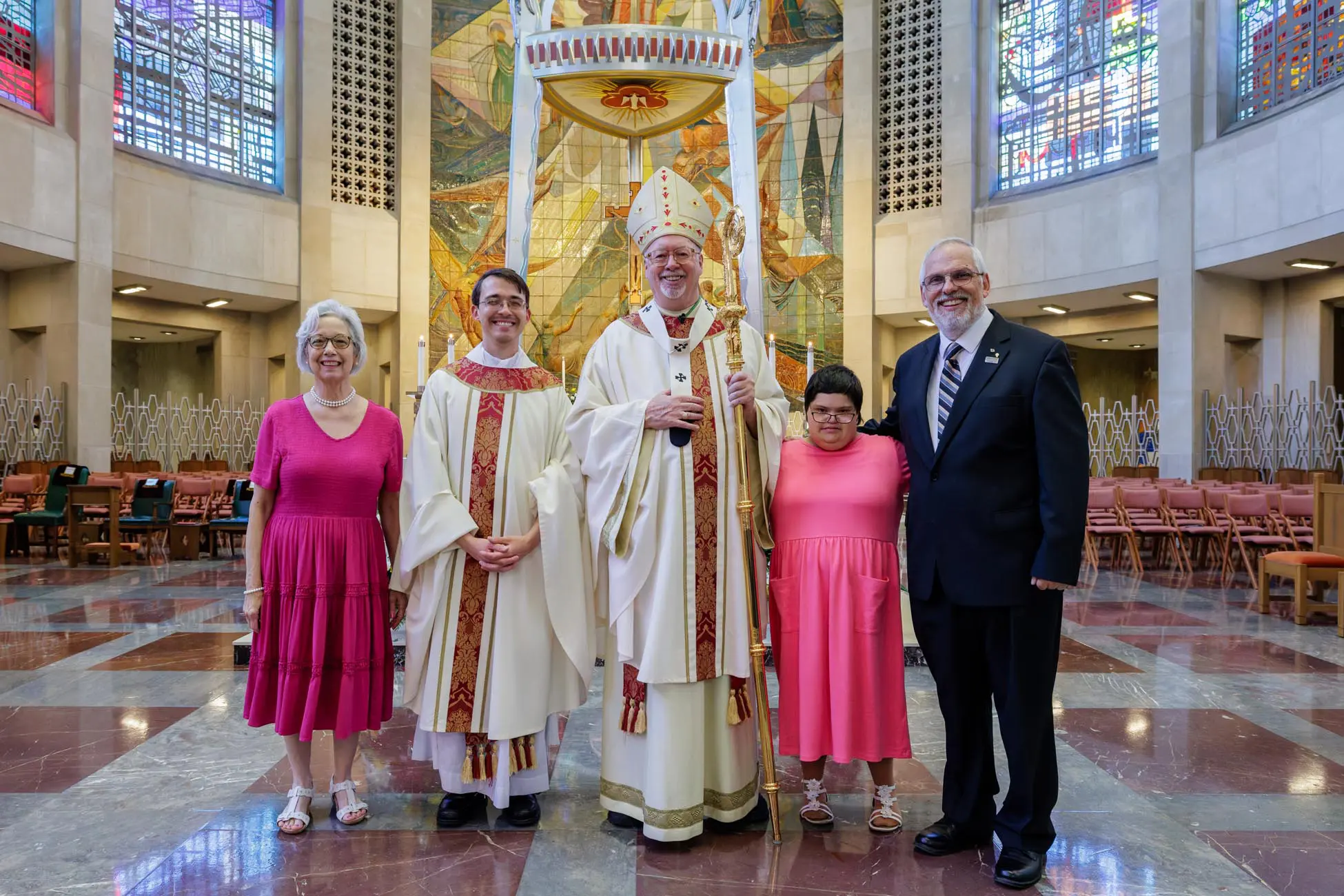
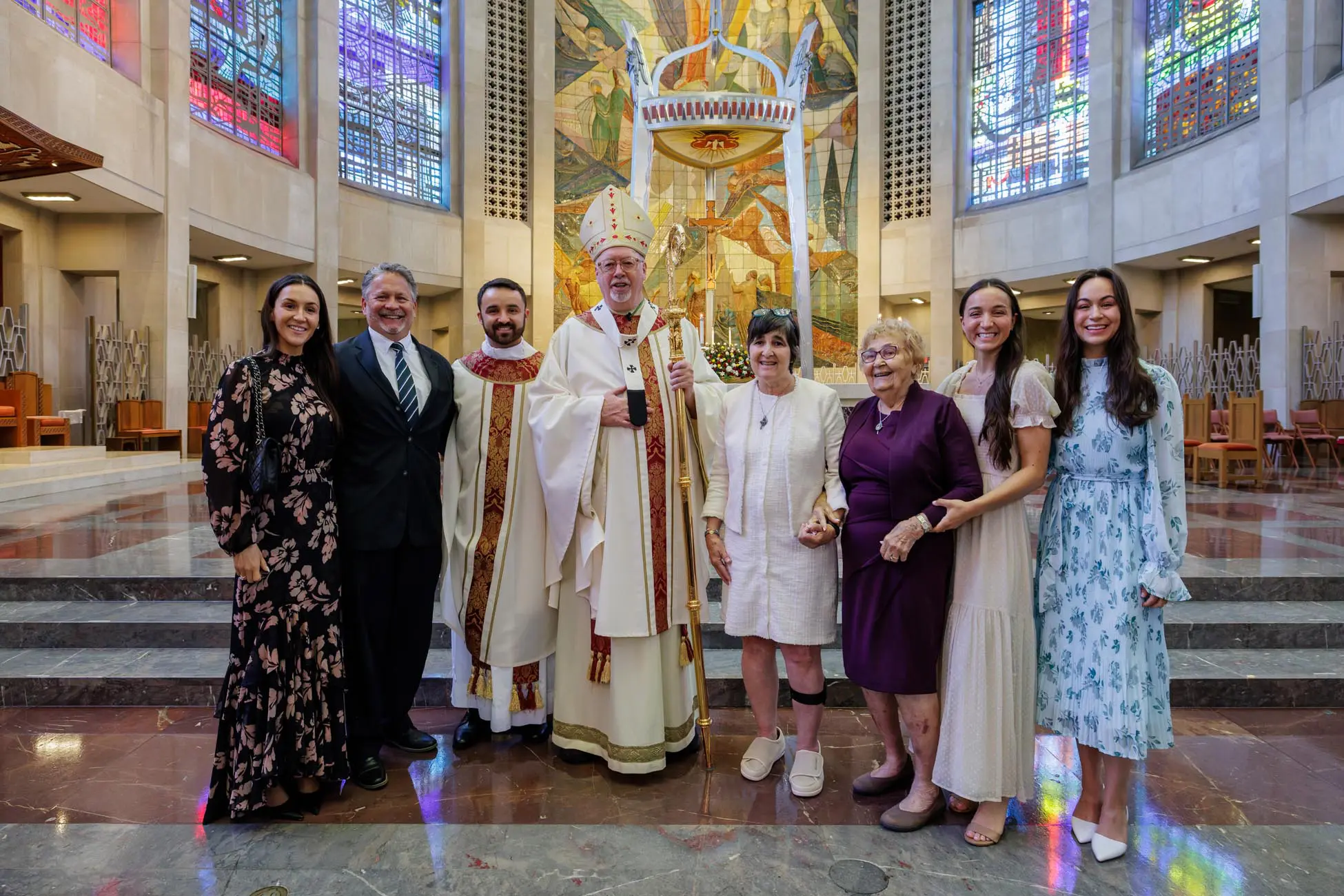
After the ceremony, the two newly ordained priests posed for photos with Archbishop Coyne and their families.

“I’m very proud of him,” said Michele Kendrioski, Father Kendrioski’s mother. “As a mother, I know in my heart that he has the right vocation.”

Florence Keszycki, Father Kendrioski’s grandmother, was also in attendance. “It was a wonderful experience,” she said of the ordination ceremony. “He is so happy. And if he’s happy, I’m happy.”

“I just feel the joy welling up in me,” said Elaine Chouinard, Father Chouinard’s mother. “Praying to the saints, while they were giving their lives to God, was so meaningful.”

As part of a long-standing tradition, and a source of great pride for parishes that produce vocations to the priesthood, the day after the ordination the new priests offered their first Masses at their home parishes, where they were brought up in the faith.

Father Chouinard celebrated his first Mass at St. Francis of Assisi Church in Naugatuck. Father Kendrioski celebrated his first Mass at St. Thérèse Church, part of St. John Bosco Parish in Branford.

As for their future assignments, Father Chouinard has been assigned to serve as parochial vicar for St. Thomas and St. Timothy Parish in West Hartford. Father Kendrioski will be serving as parochial vicar for Blessed Michael McGivney Parish in New Haven.

Father Martin Chouinard smiles for the camera with his mother, sister, father and Archbishop Coyne.


Father Mitchell Kendrioski poses with his father, mother, grandmother and three sisters as well as Archbishop Coyne.

Woodbridge Parishioners Respond to God’s Call to Help Others

Story by Joe Pisani

When Margaret Hamilton and parishioners from Our Lady of the Assumption Roman Catholic Parish in Woodbridge and Bethany went into New Haven with fresh produce from their community garden, they were met by a group of excited people at Amistad Catholic Worker.

Hamilton, who is the chair of the Faith, Hope & Charity Committee, says, “I’m not a gardener. I’m just impressed that things grow in the ground so when we bring them produce, I’m happy that they get so excited about what they plan to do with it.”

The committee, which has been active for more than 25 years, oversees programs that “help all those who need help,” she adds.

“The purpose of the committee is to be the charitable arm of the parish,” says Father Glen Dmytryszyn, pastor. “We take to heart Our Lord’s teaching in the Gospel, where he says that we should extend his heart and hands to those who are in need. We do that through charitable works and through our witness and prayer.”

Hamilton said that the initiatives the committee supports are:

*Midnight Run, where parishioners prepare 200 lunches a month that are distributed to the homeless. Since the fall of 2022, some 5,000 lunches have been made.  

*Good Samaritan Bags, which contain basic necessities, such as socks, water and toothbrushes, are given to homeless people. 

*The parish Community Garden, where the members grow vegetables in 13 raised beds, which last year harvested more than 700 pounds of produce distributed to different organizations twice a week during the summer. 

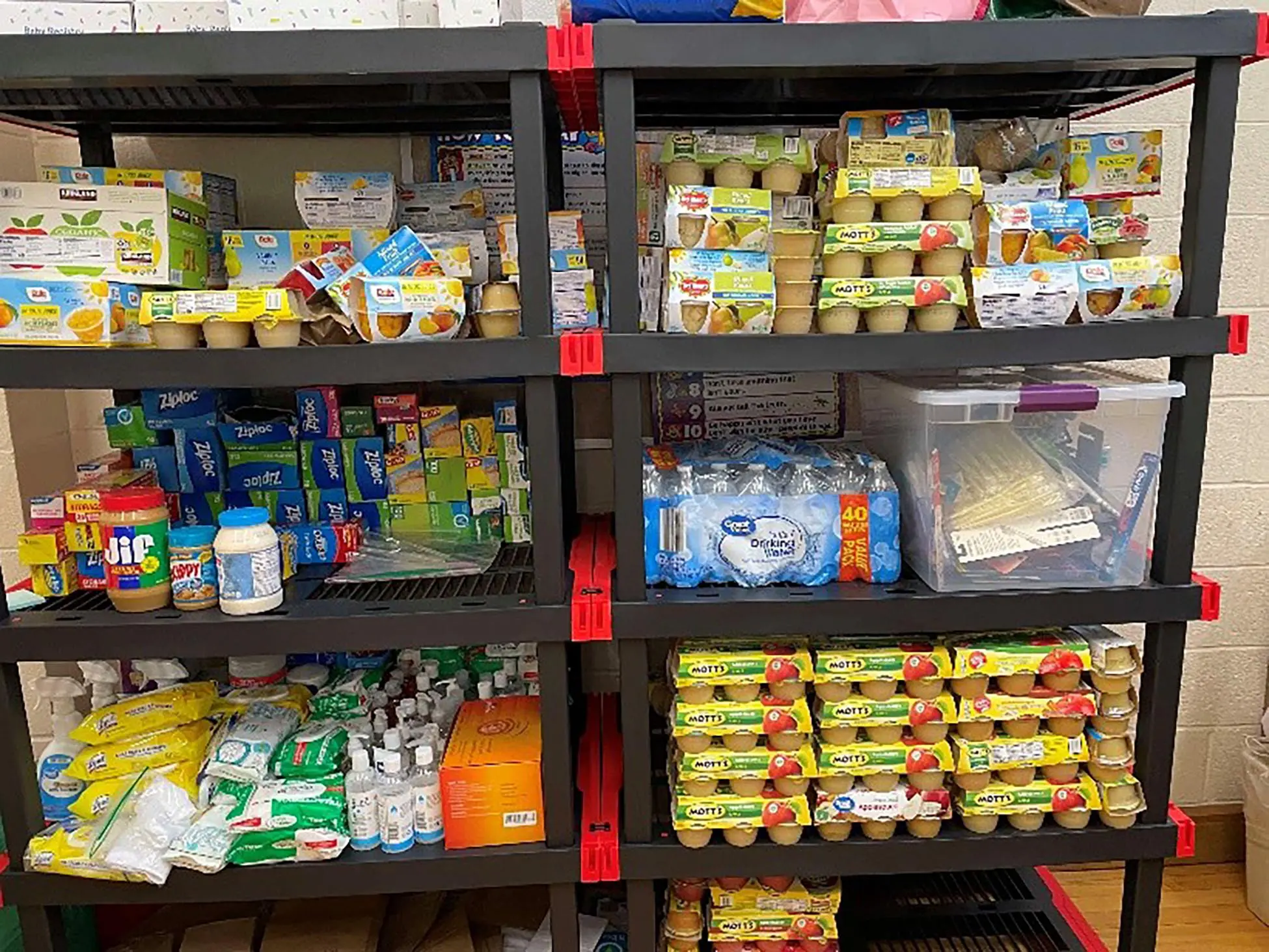
*Food drives, which benefit five groups, are held on a regular basis. 

*The annual Christmas Angel Tree program which collects toys and gifts for children and families, who might not otherwise receive any.

*Support for St. Gianna Pregnancy Resource Center in New Haven which benefits newborns, babies, single mothers and families.

*Semiannual fundraising breakfasts to raise money to support the various ministries.

“This is the impulse of what it means to be a disciple of Jesus, to do good in his name, not in our name,” Father Dmytryszyn says. “Ultimately, that’s what the Faith, Hope and Charity Committee seeks to do: to inspire faith, give hope and increase charity.”

Hamilton, who has been involved with the committee for 15 years, says there are some 25 people who participate, in addition to others who oversee the different ministries. The entire parish provides support and resources, particularly in initiatives like the Midnight Run, where parishioners stock up on food items for distribution, and the Angel Tree, which collects Christmas gifts each year.

“I like to serve,” Hamilton says. “Since I’ve been involved, I’ve gotten very close to some of the people we work with, and no matter what we do, they’re always grateful.”

Father Dmytryszyn praised the parish for its generosity and said the work of the committee is fundamental to the Church’s mission. 

“It allows us to witness to the words and actions of Christ,” he says. “As a Catholic faith community, responding to what the Lord asks us to do is pivotal. It’s never an option to extend the love of Christ. The parish is more than just a fellowship of our common faith; it’s an active participant in the faith, proclaiming Jesus Christ instilling that faith in everyone and giving hope to everyone, and sharing the charity of Christ with everyone.”

For more information about the activities of the Faith, Hope & Charity Committee of Our Lady of the Assumption Parish in Woodbridge and Bethany, contact the rectory at 203.387.7119.  

Food donated by parishioners of Our Lady of the Assumption Parish in Woodbridge and Bethany is used for regular food drives throughout the year that benefit different organizations in the area. SUBMITTED PHOTO

Public Policy Office of Catholic Church Scores Wins in State’s Legislative Session

Story by Joe Pisani

The Connecticut Catholic Public Affairs Conference achieved “successes we were happy about” during the 2025 Connecticut Legislative Session, according to Deacon David Reynolds, the Conference’s associate director for public policy. 

“Legislation dealing with abortion, transgender rights and immigration reflected the conflict between existing state law and the recently revised federal laws and regulations,” he says. “The good news is the Conference’s efforts to stop harmful legislation in the areas of abortion and gender-affirming care were successful, and we are satisfied.”

Here is a summary of some proposals and bills the Conference was involved in during the Connecticut Legislative Session that concluded on June 4. The Conference represents bishops in Connecticut. 

House Bill 7213, Elimination of Abortion Regulations: The Conference was involved in stopping the attempt to remove existing regulations that currently prohibit abortion in the third trimester. 

If approved, it also would have ended medical providers’ right to refusal to participate in an abortion and removed a state requirement “to provide emergency medical treatment for an infant born alive following a failed attempt at an abortion,” the deacon says. 

Senate Bill 7, Religious Freedom for Catholic Hospitals: If approved, this bill could have prevented Catholic hospitals from ensuring their medical staff adhere to the Ethical and Religious Directives for Catholic Health Care Services, promulgated by the U.S. Conference of Catholic Bishops. These directives define how a Catholic hospital must conduct itself in areas including abortion, gender-affirming care and assisted suicide.

“The Conference was involved in amending the bill to remove language that threatened religious directives that the Catholic hospitals operate under,” Deacon Reynolds says. 

The Conference opposed Senate Joint Resolution 35, Abortion/Gender Identity Constitutional Amendment, that could have led to a constitutional amendment to eliminate the possibility of any limits on abortion and “made transgenderism a protected class under the State Constitution,” the deacon says, “thereby overriding protections that religious institutions currently have regarding gender and sexual ideology.”

House Bill 7212, Social Justice/Trust Act: Connecticut’s Trust Act limits the ways in which local and state law enforcement may interact with U.S. Immigration and Customs Enforcement agents. The Conference supported the bill, which would make modifications to the Trust Act.

House Bill 7012, Education/Antisemitism: The Conference supported a bill to create a group to study the rise of antisemitism in public schools. “The growing antisemitism in our state is a threat to people of all faiths,” Deacon Reynolds says. “And our children must be taught how truly harmful such actions and viewpoints are to a free society.”

House Bill 6894 Social Justice/Housing: The Conference supported this bill to establish an Interagency Council on Homelessness. “This interagency council will try to come up with long-range plans to deal with homelessness and make sure the different state agencies work together,” Deacon Reynolds says.

The Conference opposed House Bill 6804 that would have taxed private schools providing housing for their teachers. This bill would have impacted very few Catholic schools in the state. 

Although it was approved, the Conference opposed House Bill 7014 which would have created a process to handle complaints about inappropriate materials available in public school libraries. 

“This was an effort to actually minimize parental input on objectionable material,” Deacon Reynolds says. “We will be monitoring this very closely in the future.”

To stay informed of issues the Connecticut Catholic Public Affairs Conference is involved in, visit ctcatholic.org or call 860.524.7882.

Derby School Showcases Countries Around the World 

Story by Karen A. Avitabile

Students from St. Mary-St. Michael School in Derby took part in a first-time, hands-on “Around the World” project to learn more about different countries.

Each grade chose a country and learned about its geography, history, holidays, traditions, food, fashion, landmarks, language, sports, music, religion and so much more. 

“Everybody did something different,” says Toni Ann LaMattina, principal of St. Mary-St. Michael School. “I gave them free rein.”

Some of the featured countries included Germany, Guatemala, Italy, Japan and Poland.

“This was an opportunity for the students to show off their work,” LaMattina says. “We never had a themed activity. This was a new thing.”

To showcase their country, each classroom wrote reports, decorated bulletin boards, created flags and gave presentations during an evening open house. A few multicultural dishes were prepared for guests to enjoy.

“In my first year as principal, it was so amazing to see the students show off their hard work that they completed in class,” LaMattina says. “They were smiling from ear to ear, showing their parents and they were so welcoming to the new families that came in for a tour of our school.”

The eighth grade class focused on Italy. One student studied a particular city in the country. “I learned a lot about the history of Basilicata, Italy,” says student Shenaye. “It is very historical. I feel history builds our future.”

Guatemala was the class project selected by sixth graders. The students focused on the significance of the country, its geography, renowned landmarks and the country’s flag. 

The three-panel, vertical flag is adorned by blue stripes on the left and right sides, which represent the Atlantic and Pacific oceans. The white stripe in the center represents peace and highlights the coat of arms shield of Guatemala, adopted after the 1871 Liberal Revolution.

Zarah says she enjoyed writing about Guatemala’s flag. “I learned about the stripes,” she says. 

Fourth graders chose Germany for their country. Matias wrote about the history of the Berlin Wall. “I chose the Berlin Wall because back then, Germany was divided and East Germany built it to stop the people crossing the border,” he wrote in an essay. “Today, you can still go there. Now it’s possible to pass the city with no worries.”

For Delia, she says learning some German words was a lot of fun. She adds she was surprised that hamburgers and pretzels are popular foods among German residents.

Around the World culminated with an evening open house. Parents, guests and new families to the school were invited to see the work by the students. 

“The event was a great success,” LaMattina says. “We had many school families along with a handful of new families. I received much positive feedback from this event, and I plan to continue with it each year and change up the theme.”

The day after the open house, the principal recalls students asking her if they can do the project again next year “which showed that it was all worth it.” 

The teachers enjoyed Around the World too, LaMattina says. “Not only did the students enjoy this project, but the teachers did as well.”

Zarah, Jude and Ava, left to right, stand by a display of Guatemala which includes pictures, books and information about the flag. Guatemala, a country in Central America, was chosen by sixth graders as their class project for Around the World at St. Mary-St. Michael School. PHOTO BY KAREN A. AVITABILE

Catholic Transcript: Summer 2025

Pope Leo XIV and the Challenge of Artificial Intelligence

Story by Joe Pisani

In the last class of the semester, one of my students gave an impassioned speech about the dangers of artificial intelligence. I wish Pope Leo XIV could have heard it, because two days later the newly elected pontiff offered his own sobering account of why we must be cautious of where AI is taking us. 

“In our own day, the Church offers to everyone the treasury of her social teaching in response to another industrial revolution and to developments in the field of artificial intelligence that pose new challenges for the defense of human dignity, justice and labor,” Leo XIV, said in his first address to the College of Cardinals.

The challenges it presents are more insidious than those society confronted during the Industrial Revolution, when Pope Leo XIII wrote the encyclical “Rerum Novarum” about workers’ rights and capitalism.

Like most of us, my student was astonished at AI’s ability to solve his problems at his customer service job. He got an immediate response to a customer’s question about how many bags of cement would fit into a truck he rented. 

It was a pedestrian question, but that simple encounter demonstrated the temptation AI has for us. We’re intoxicated by its potential, when we should be wary of its threat.

Enter Pope Leo, who has said AI will be a fundamental concern of his papacy.

Deep fakes in porn and politics, misinformation, intellectual property infringement, not to mention Mark Zuckerberg’s prophetic vision that in the future we’ll be blessed with AI friends to allay the loneliness. 

Pope Francis also issued a warning about AI’s ability to “create partially or completely false narratives believed and broadcast as if they were true.” And in January, the Vatican published a document about the limitations of AI and the ethical issues surrounding its development and use.

Artificial intelligence reminds me of that famous “Twilight Zone” episode about the benevolent 9-foot-tall aliens called Kanamits, who came to Earth to solve all our problems, bring peace, prosperity and technological progress with the goal “To Serve Man,” which was the title of their manifesto. Humanity would eat, drink and be merry … until someone translated “To Serve Man” and discovered it was actually a cook book.

I have friends who are taking a “let’s wait and see” attitude, and find ChatGPT useful in drafting letters of recommendation and other documents, even though someday that helpful program will probably have their jobs. 

Writers are already in the crosshairs, with an estimated 30 percent of jobs disappearing, and some media companies are using AI to produce stories about real estate and sports. Non-profits are even relying on AI to create press releases.

When it comes to being expendable, journalists are at the top of the list, along with software engineers, cashiers, factory workers and many others. 

AI has also led to rampant cheating in colleges and high schools. Last year, I asked a class to critique a TED Talk by a famous defense attorney, and I was surprised and proud when I read their submissions. 

“These are pretty good,” I thought, “I’m getting through to them.” 

But the joke was on me. After reading a few assignments, I began to detect the same phrases, the same adjectives, the same observations and it occurred to me that ChatGPT was the actual author. 

Now, when I give them writing assignments, I utter the same plea: “I want your original work. I prefer your flawed human intelligence to artificial intelligence. Don’t go over to the dark side.” It’s often to no avail because the temptation is too great, and the deception is too easy to pull off. For a time, I was running the work through an AI detector, but it added hours to the grading process.

Another professor I know at a respected Jesuit University is so distraught that he requires his students to do their writing assignments in class. It’s a less-than-perfect solution because it takes away from time that could be spent more productively in discussion and debate.

In another class, I asked the students about their career aspirations and got responses that included finance, health care, design, journalism and education. 

I sighed and gave them the bad news, which probably never occurred to them. This toy they love tinkering with will probably be responsible for their jobs disappearing. Who’s going to need a graphic designer in five years? 

In articulating his vision, Pope Leo XIV rightly identified artificial intelligence as one of the most critical issues of our time, a technological development that could threaten the future of humanity while it promises to save it. Sounds like the Kanamits to me.