Skip to content

Jubilee Year of Hope Beckons All Catholics

Story by Shelley Wolf

The “2025 Jubilee Year: Pilgrims of Hope,” declared by Pope Francis, is a rare opportunity for special graces. Father Michael Ruminski, the archdiocese’s director of Divine Worship, attempted to demystify the “Jubilee of Hope” during a recent Theology on Tap event hosted by St. Bridget of Sweden Parish in Cheshire.

He answered three basic questions: What is a jubilee? What is the Jubilee of Hope? And how can we celebrate it well?

According to Father Ruminski, the term “jubilee” can be traced back to the Latin term meaning “to sound a trumpet.” Its roots go back to Mosaic law in the Old Testament, when it was a special year of rest and forgiveness every 50 years.

In Old Testament times, the jubilee involved the forgiveness of debts, the release of indentured servants and the return of ancestral inheritance. “It was supposed to be a kind of resetting of societal obligations in which you begin again,” Father Ruminski explains.

The jubilee was introduced into Catholic Church life by Pope Boniface VIII in 1300. By 1500, jubilees were celebrated every 25 years. The Christian jubilee put greater emphasis on spiritual reconciliation: freedom from sin, forgiveness, and peace. Pilgrimages and plenary indulgences were added.

The current Jubilee of Hope designated by Pope Francis is focused on the virtue of hope and its importance in the modern world.

Pope Francis has identified people in need of prayers or visits, Father Ruminski notes, because they have lost hope: young families afraid to bring children into the world, young people fixated on drugs or technology, the forgotten elderly and the sick, migrants and refugees fleeing dangerous places, and forgotten prisoners.

Hope is essential, Father Ruminski says, in facing the challenges of the world and in proclaiming the message of Christ. “Hope is the virtue given to us by God to direct our expectations for the future,” he says. “Without hope, we have no ability to face the future with confidence.”

Instead of ruminating on our challenges, he suggests we “look at the world with the supernatural eyes of faith.”

“As St. Paul says, ‘hope does not disappoint,’” Father Ruminski reminds us. Rather than let the problems of the moment “dominate us,” we should “proclaim something of power to the world around us.”

“It’s the light of Christ, through his victory on the cross, that should direct the way we interact with each other,” he explains, “for us to be able to live right, to be able to forgive well and to be able to proclaim Christ crucified and risen. And so we have to have hope in order to do that.”

Other practical steps for celebrating the Jubilee of Hope include making pilgrimages to one or more designated cathedrals or basilicas: St. Peter’s Basilica and the major basilicas in Rome or, closer to home, the Cathedral of St. Joseph in Hartford and the Basilica of the Immaculate Conception in Waterbury.

While there, pilgrims are encouraged to engage in the sacraments and acts of prayer: attend a Mass, go to confession, pray in adoration of the Blessed Sacrament or pray the rosary or the stations of the cross.

Conditions for receiving a plenary indulgence include confession, praying for the pope’s intentions, receiving Holy Communion and being detached from sin.

For more information on how to make a pilgrimage and on plenary indulgences, click here.
A Family Ritual Worth Remembering

Story by Joseph Pisani

If you travel north on Route 3 in New Hampshire, you’ll pass the tourist attractions in the Lakes Region and then head into the White Mountains.

Along that long and winding state road is a small cemetery in a town of 800 people called Twin Mountain. Perhaps the most famous grave there belongs to the “Hermit of Crawford Notch,” John Vials. Known as “English Jack,” he died at 85 on April 24, 1912. He lived in a small shack along the railroad tracks and was a legend in those mountains.

What strikes me most about this small country cemetery is the number of benches where people can sit, pray and spend quiet time with those they’ve lost. 

What happened to that ritual? At one time, we regularly visited the graves of our deceased loved ones and prayed for their souls, confident in the knowledge they would pray for us, too, before the throne of God. 

A few times a year, I’ll visit my parents’ grave on a hill in Shelton, overlooking the Housatonic River, which flows peacefully to Long Island Sound. On spring afternoons, there are goldfinches twittering in the trees as the sun filters through the branches and onto their granite stone, which says, “In God’s Care,” with a rosary engraved around a cross.

One day I thought I was alone until I heard someone. Nearby, an elderly man was sitting in a lawn chair, talking to his deceased wife. I could tell he visited her often, and the conversation probably sustained him in what was likely the lonely grief that often accompanies us in later life.

I was reminded of scenes in the “Rocky” movies, where the retired heavyweight champ played by Sylvester Stallone visits his late wife, Adrian Balboa, who died at 51 of cancer between the fifth and sixth movies. To film those scenes, Stallone had a granite gravestone placed in Laurel Hill Cemetery in Philadelphia, where he would visit Adrian and sit on a wooden chair while he told her about the challenges he faced in his life without her.

That gravestone is still there, and thousands of fans were so moved by those fictitious scenes of grief that each year they visit it. The engraving simply says, “Adrian Balboa, March 10, 1950–January 11, 2002.”

It brought back memories of my childhood, when my mother would take us every Sunday after Mass to St. Michael Cemetery in Stratford, where we’d visit grandparents, parents, aunts, uncles and cousins. It was somewhat of a weekly family reunion. My responsibility was to carry the watering pail and walk to the spigot and fill it so we could water the geraniums planted around the headstones.

After tidying up the graves, we would say our prayers, wish our relatives well and ask for their prayers. We weren’t the only ones. The cemetery was crowded with other families, who were also paying their respects.

Even though we kids had other things we preferred to do on Sunday morning, our mother was resolute that this was an obligation we had to fulfill. No debate. She politely but firmly explained it was our responsibility to remember and pray for those who had gone before us. 

Looking back, I realize it was also a ritual that assuaged the grief she must have felt. 

I confess that when I visit my parents’ grave, my approach is a little different. I talk to them too, but my conversation — which I hope no one overhears — goes something like this: “Mom, Dad what are you doing up there? Help us. This world is a frightening place. So many of our family members have fallen away from the faith. Pray harder please because we need help down here.” (That’s only a slight over-dramatization.) 

I have no doubt that we have to return to the family rituals that sustained the bond between the living and the dead … and kept us together. 

So take time to pay respects to your deceased family members and friends. You won’t regret it. Praying for the dead is a spiritual work of mercy. Visiting their graves is also a reminder of our own mortality and the importance of working toward our salvation. 

One more thing: If we pray for their souls, we can be assured they’re praying for ours. 


Evening Online Prayers Bring People Together 

Story by Karen A. Avitabile

Several parishioners of St. Josephine Bakhita Parish in Rocky Hill are participating in meaningful online evening prayer broadcasts through Facebook to stay connected to God and their parish. 

“Facebook makes it easy to do,” says Father George Couturier, pastor of St. Josephine Bakhita, who leads the evening prayer streams during the week on Facebook. “I just set up my laptop (in the rectory) and aim it at my face.”

The priest’s broadcasts can be viewed at 5 p.m., Mondays through Fridays, by following facebook.com/saintjosephinebakhita.

Some people join Father Couturier when the broadcasts first air on Facebook; others watch it later in the evening. The broadcasts also include the actual text of the priest’s spoken words.

Father Couturier launched the prayer service on Facebook in March 2020 after public Masses were suspended during the coronavirus pandemic.

“The pandemic hit,” he says. “It was the perfect time to do it. We were planning to do something before the pandemic.”

After in-person Masses resumed in June 2020, Father Couturier’s online prayer broadcasts had a captive audience. The parishioners, who make up St. Elizabeth Seton and St. James churches, asked the priest to continue the broadcasts.

“We received positive response,” Father Couturier says, adding the prayers have been uplifting for many of the viewers. “Some are shut-ins and some just want to hear a calm voice. It’s just an opportunity to pray together.”

The online evening prayer broadcasts reach about 200 people consistently, says Lisa Orchen, parish communications coordinator. For many people, she adds, the broadcasts have become an essential part of their own “spiritual routine.”

“Couples share that they participate in evening prayer together with Father George leading them every evening,” Orchen says. “Similar to daily Mass, evening prayer participants post words of deep appreciation for Father George’s nightly ritual consistency and for offering this daily prayer practice for all to follow and join with.”

Father Couturier says he prefers to broadcast his daily prayer messages on Facebook in the evening after people have settled in at home from a long day.

“They seem to touch the heart,” he says of the broadcasts. “People need to unload, rest and go to sleep. People prefer to go to bed with those prayers in mind.”

Currently, Father Couturier’s broadcasts include Lenten messages using “Give Us This Day,” a prayer resource that aids in fostering a deeper connection with God. Viewing spikes for the broadcasts usually occur during Lenten and Advent seasons when more people are tuning in. 

In addition to the online evening prayer broadcasts, livestreams of Masses take place each Sunday morning from one of the Rocky Hill churches. 

“We have strong consistency with our real-time livestream participants,” Orchen says. “The majority of these participants are folks who are deeply connected to our parish but are home or assisted living/nursing homebound due to health and age. We also have folks who are longtime parishioners who now live geographically distant for all or part of the year, and stay connected to the parish through the livestream.”

Putting a Smile on the Faces of Children

by Joe Pisani

Little Miracles ministry provides assistance for families.

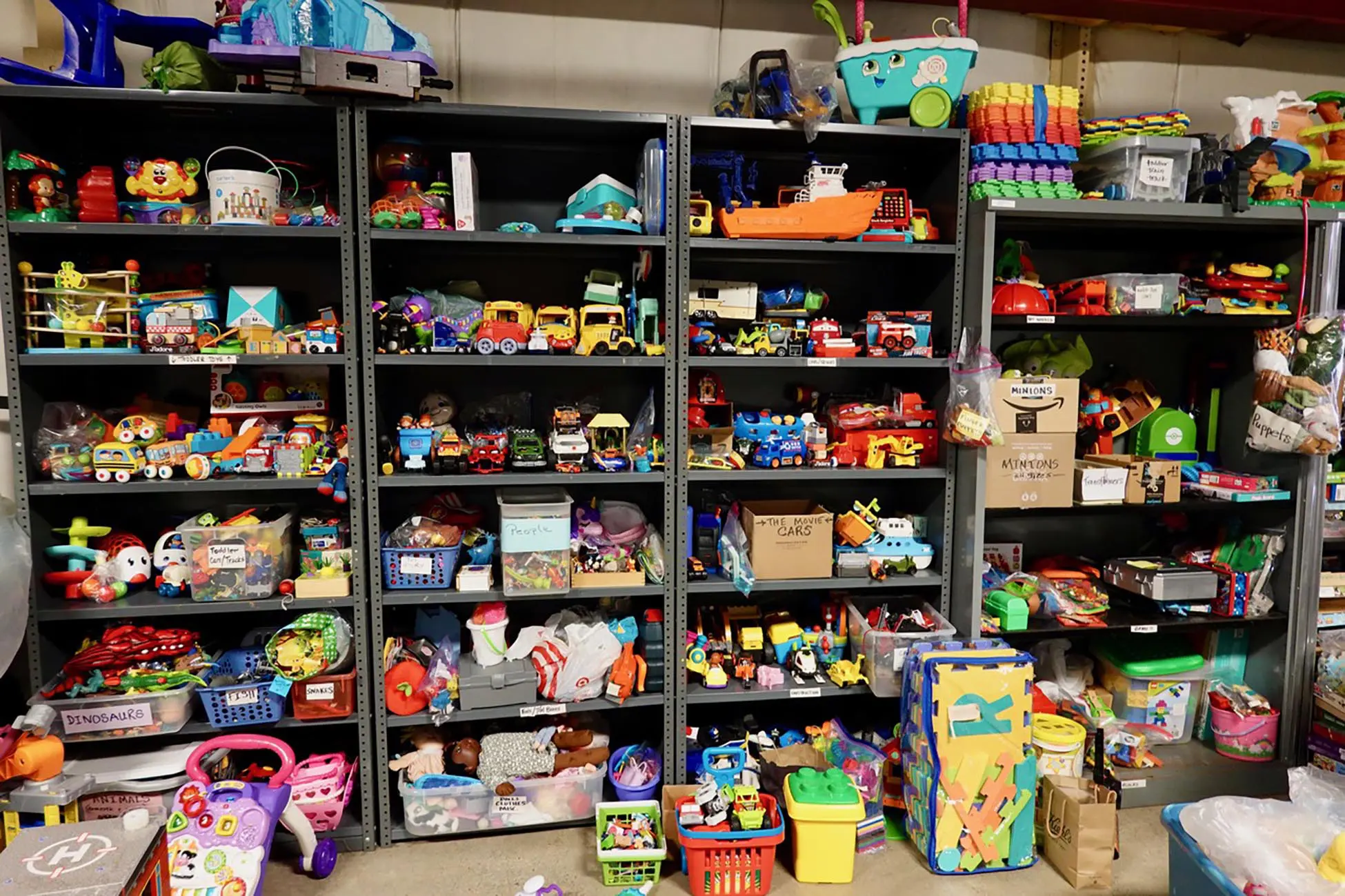
At Christmastime, Barbara Ciotti called 20 families whose children probably wouldn’t find toys from Santa under the tree. Then, she and her volunteers from the Little Miracles ministry of St. Margaret Church in Madison and St. George Church in Guilford performed a little miracle of their own. 

They scoured their warehouse, taking toys and stuff animals off the shelves, and delivered them to the families in time for the holiday.

“If we hadn’t done that, they probably would’ve had nothing to celebrate at Christmas,” says Ciotti, coordinator of the respect-life ministry, which for almost 30 years has helped needy families and single parents with young children by providing diapers, clothing, car seats, strollers, toys and other baby items donated by parishioners and community members.

“We distribute them to people in about seven towns from West Haven to Westbrook,” she says at their Branford storage facility, where volunteers unpack donations and prepare them for delivery. “We take in donations and give out donations to anyone who needs them, and the need is great.” 

People drop off things at the parish center or come to the warehouse. Social service agencies often refer their clients to Little Miracles. 

At Christmas, clients receive a Walmart gift card; at Thanksgiving, St. George Church supplies turkeys; and at Easter, holiday baskets are passed out to families.

Little Miracles assists some 100 families a year with children usually up to 6 years old.

“I recently got a call from a social service agency about a woman who has five children, and were probably living in a shelter,” Ciotti says. “They all needed something. We try to make it better so the kids can smile.”

She recalls a woman Little Miracles has helped from the time she had her first baby. Now, she has four children, three who are suffering medical issues, and no husband. She also lost her housing. 

“She is a wonderful person and a great mom who has had terrible luck,” Ciotti says. “Those of us who have money often don’t realize the need. It’s hard to look the other way.”

Little Miracles was started in 1996 by a group of women led by the late Lily Molloy. Ciotti has volunteered for 18 years and been coordinator for 15.

“We store a lot of these items in a small warehouse space that has been donated to us,” Ciotti says. “But we need to move again and are looking for a space approximately 1,000 to 1,500 square feet in the Guilford-Branford area that can be our ‘forever home.’”

The volunteers are kind-hearted people who want to do their part, Ciotti adds, but more are needed. Also, a new coordinator is needed for one day a week.

Sue Croce, who began volunteering at Thanksgiving, says, “I’m a grandmother who has a soft spot in my heart for babies, and I wanted to give back.” 

Her colleague, Jackie Roe, has been with the ministry a year and describes the work as “pure fun.” Volunteers also include Fran Aquarulo, Judy Shauk, Margaret Healy and Paula Filippone.

(Little Miracles volunteers meet on Tuesdays, 10 a.m. to 12:30 p.m., at a storage area in Branford to organize donations and package items for distribution. For information about making donations or volunteering, contact Barbara Ciotti at 203.464.2644.)

PHOTO BY JOE PISANI – Little Miracles has shelves filled with toys for children.


Seminarians and Priest Studying in Rome Thank Appeal Donors

Story by Shelley Wolf

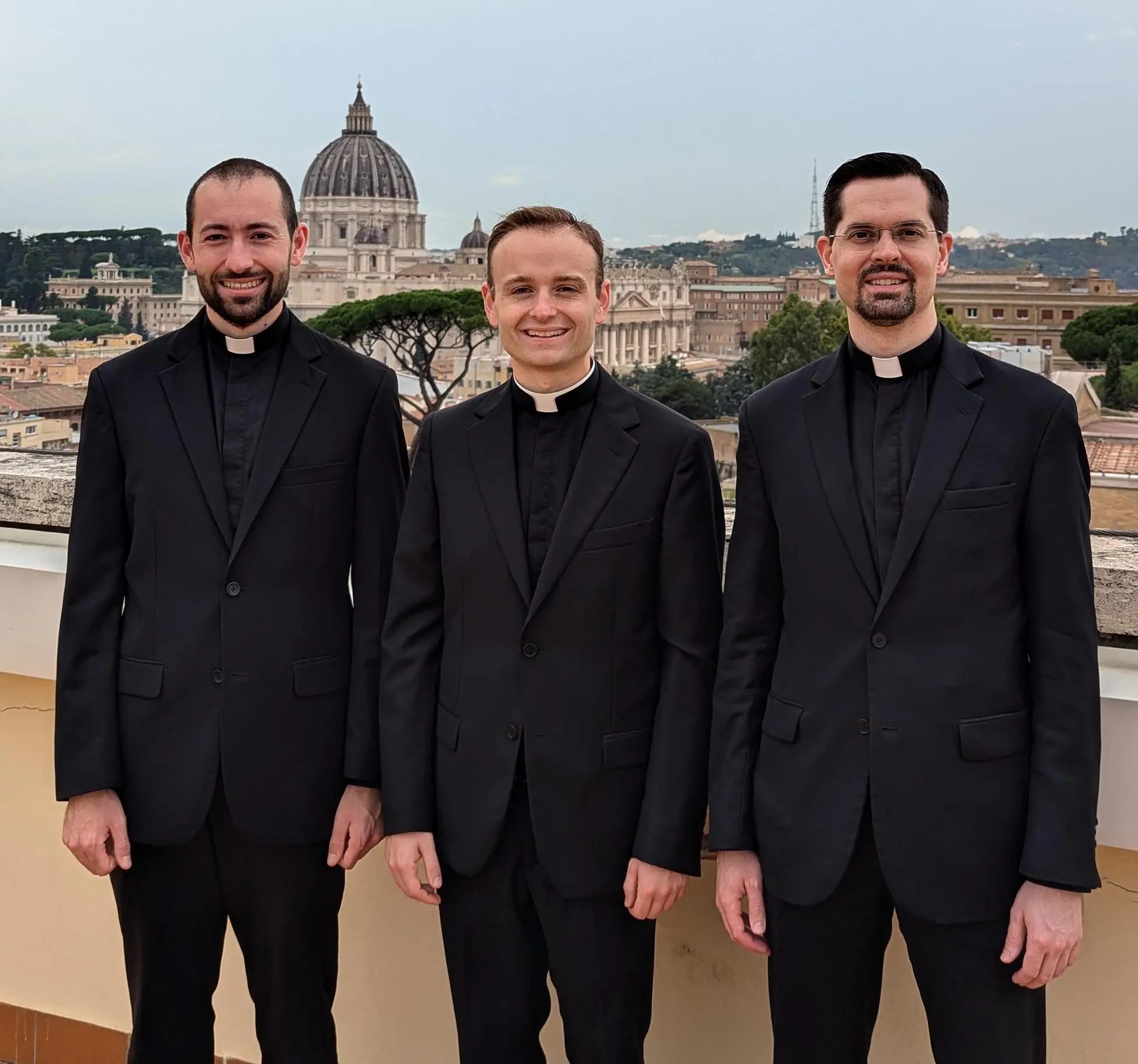
Three men from the Archdiocese of Hartford, who are studying in Rome, are thanking the donors of the Archbishop’s Annual Appeal for sponsoring their priestly education and for providing them with an international formation experience.

“Thank you for your gifts,” says Nicholas Chapman, “which make it possible for me to pursue the path I believe God is calling me on. This time in Rome has particularly stretched me and blessed me.”

Brendan Finnegan says, “My prayer is to be able to let these experiences form my heart so that I can be an effective servant of the Gospel to you and your family, for generations to come.”

Finnegan and Chapman, two seminarians for the Archdiocese of Hartford, and Father John Gancarz, a priest from the archdiocese, are all thrilled to be studying theology at universities so close to the Vatican. They are also making friends with other Catholics from around the world, and absorbing the fact that they are part of a faith that counts nearly 1.4 billion followers.

The coursework is challenging and the three men are far from home, separated from family and friends even over the summers. Still, they are grateful for the opportunity to study in Rome.

Finnegan and Chapman, both in their second year of theology studies, reside at the North American College and attend the Pontifical Gregorian University, the oldest Jesuit University in the world. It’s quite different from their earlier seminary experience.

“Unlike my prior seminary,” Chapman says, “where our studies were under the same roof as where we lived, it’s kind of neat to ‘go off to work’ in Rome and come back home again after classes are done for the day.”

Coursework for the seminarians ranges from Canon Law to the Letters of St. Paul to Ancient Greek. And all courses are taught in Italian. “The language of instruction and collaboration is most often Italian,” Father Gancarz explains.

In addition to studying, the seminarians have volunteered in Rome to serve the poor, worked in parishes, learned Italian and Spanish, and visited sacred sites in nearby countries. 

And they have marveled at the Italian people. “The Italians typically don’t get too stressed out about the little things,” Chapman observes.

Father Gancarz, who last served at Sacred Heart Parish in New Britain, now lives in Casa Santa Maria, a residence in Rome for American diocesan priests. He attends the Pontifical University of St. Thomas Aquinas, a Dominican university, where he is working on a Doctorate in Sacred Theology with a specialization in dogmatic theology.

“In the Gospel of John we hear the words of Jesus, ‘I am the way and the truth and the life. No one comes to the Father except through me’ (John 14:6),” Father Gancarz reminds us. “The aim of all our studies is knowing more deeply this ultimate truth, Jesus Christ, and then sharing him with others.”

His graduate work and the other men’s undergraduate studies are thanks to the generous donors of the Archbishop’s Annual Appeal.

“We are incredibly grateful for the support of the donors,” says Father Gancarz. “May this time in the eternal city enrich our faith and priesthoods, to be better ministers and servants to the faithful in the archdiocese and beyond. We pray for you!”

For more information or to donate to the Archbishop’s Annual Appeal, visit archdioceseofhartford.org/appeal.

Nicholas Chapman, Brendan Finnegan and Father John Gancarz, from left to right, are studying in Rome.

New Pilgrim Icon Depicts Image of the Sacred Heart of Jesus

Story by Karen A. Avitabile

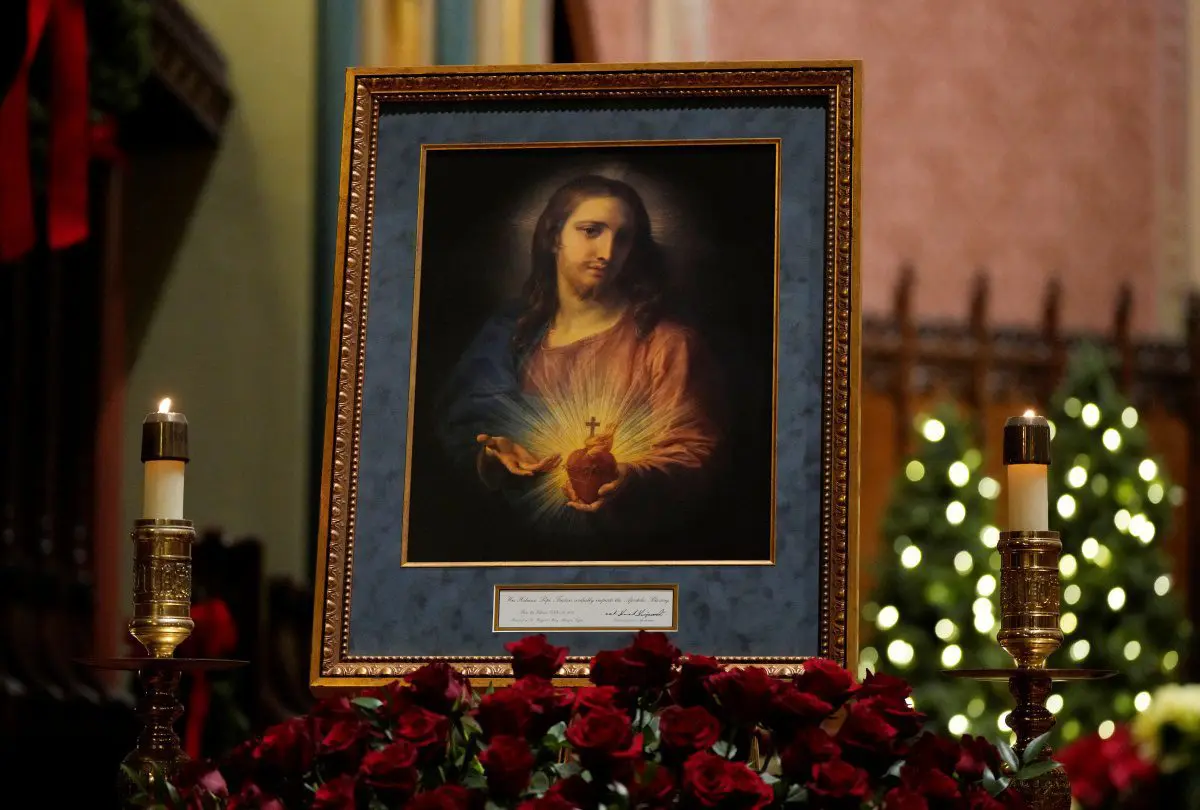
A reproduction image of the Most Sacred Heart of Jesus is making its way around the world and may be viewed in parishes in the Archdiocese of Hartford this year.

This reproduction is one of more than 300 icons, each bearing the Apostolic Blessing of Pope Francis. It is the most recent addition to the Knights of Columbus traveling pilgrim icon program. The icons are currently traveling around the world as part of the Knights of Columbus Pilgrim icon program.

The Sacred Heart of Jesus pilgrim icon program was launched by the Knights of Columbus on Jan. 3 at St. Mary Church, part of Blessed Michael McGivney Parish in New Haven. During that prayer service, an icon depicting the most famous image of the Sacred Heart of Jesus — painted by Pompeo Batoni in 1767 and now venerated in the Church of the Gesù in Rome — was displayed for veneration. It bears the blessing of Pope Francis through the Papal Almoner.

The Sacred Heart of Jesus pilgrim icon program also coincides with the 350th anniversary of the visions of St. Margaret Mary Alacoque, a French Catholic nun who gave the Church the Twelve Promises of the Sacred Heart and the First Friday devotions.

In one of the apparitions, Jesus Christ told Alacoque: “Behold this Heart which has so loved men that it has spared nothing, even to exhausting and consuming itself, in order to testify its love.” This quote is central to the Sacred Heart of Jesus Catholic devotion. The heart refers to Jesus’ physical heart and his boundless love for mankind.

Pope Clement XIII officially recognized and approved the devotion to the Sacred Heart of Jesus in 1765, some 75 years after St. Alacoque’s death. In 1920, St. Margaret Mary Alacoque was canonized by Pope Benedict XV. Today, she is recognized as the patron saint of people who suffer from polio, the loss of a parent and those who devote themselves to the Sacred Heart.

The publication of the fourth encyclical of Pope Francis, Dilexit Nos (He Loved Us), is devoted to the Sacred Heart. “In many ways, Dilexit Nos can serve as a mission statement for the Knights of Columbus in today’s world,” Supreme Knight Patrick Kelly says. “The pope observes that we live in a fragmented and divided society, but the heart of Christ is a unifying center. It is the source of truth and goodness that we all need.”

Archdiocese of Hartford priest and Knights’ founder Blessed Michael J. McGivney was deeply devotion to the Sacred Heart. His family displayed an ornate devotional plaque of the Sacred Heart in their Waterbury home. The plaque is still in the Knights’ possession and is on display in the Blessed Michael McGivney Pilgrimage Center in New Haven.

The Sacred Heart of Jesus is the 20th traveling pilgrim icon venerated through the Knights’ program since its formation in 1979. Our Lady of Guadalupe was the first pilgrim icon. Since then, the program has enabled more than 23 million people to honor Our Lord, Our Lady and the saints.

Parishes in the Archdiocese of Hartford should contact their local Knights of Columbus council to host the icon for veneration and schedule a Sacred Heart holy hour. For more information about the Knights of Columbus pilgrim icon program, visit kofc.org/sacredheart.

The new Knights of Columbus Sacred Heart traveling pilgrim icon was on display for veneration before the Jan. 3 Mass at St. Mary Church, part of Blessed Michael McGivney Parish. (Photo by Paul Haring)

Catholic Transcript: Spring 2025

New Haven Parishioners Celebrate Black History Month in Musical Style

Story by Shelley Wolf

There was no yawning in the pews at the 10 a.m. Mass on Sun., Feb. 23 at St. Martin de Porres Church in New Haven, as the parishioners of Blessed Michael McGivney Parish came together to celebrate the fourth week of Black History Month.

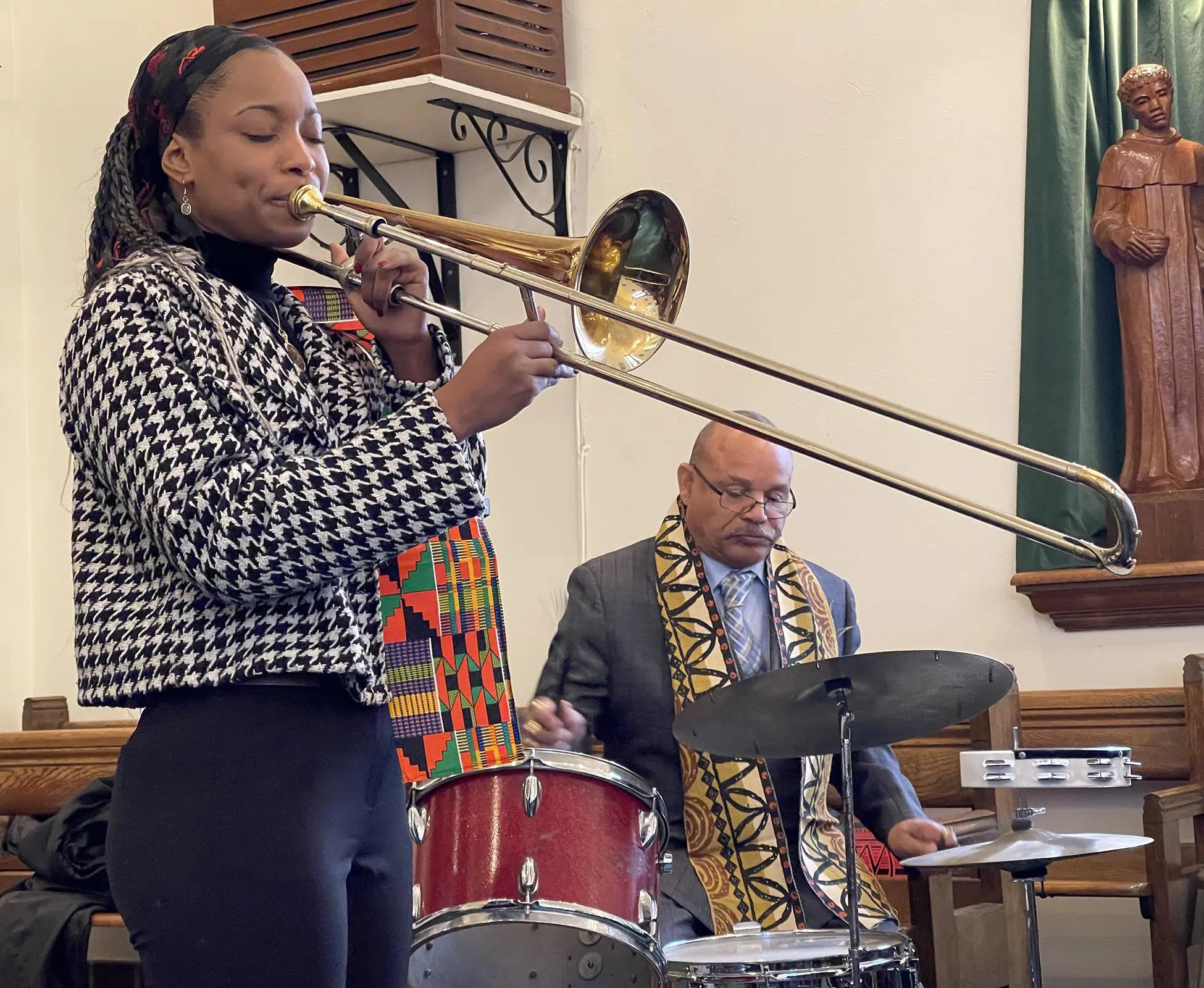
In addition to a full Mass celebrated by their parochial vicar, Father Joseph MacNeill, parishioners were treated to lively hymns by the St. Martin de Porres Gospel Choir as well as trombone accompaniment and a solo by Naomi Wharry, who is currently pursuing a classical trombone degree at Yale.

“I Found It All in the Word of God,” sung by the choir during the collection, had parishioners swaying in their seats to the rousing gospel hymn. Later, Wharry mesmerized the congregation with an unexpectedly quiet reflective instrumental meditation piece on the trombone.

Prior to the close of the Mass, parishioner Patricia Mason lauded a number of accomplished members of the St. Martin de Porres Church community.

Wharry, the guest trombonist, is an Oklahoma native who grew up in a family of eight. In addition to studying classical music at Yale, she plays in a professional jazz quartet.

Nelson Tamakloe, who directs the choir and accompanies on organ and piano, studied music theory at Yale and is the former director of the Yale Gospel Choir. According to Mason, Nelson, who lives in Massachusetts and had car trouble one day, took the train to New Haven and walked to St. Martin de Porres Church rather than miss a rehearsal days before the choir’s Christmas Eve performance.

Calling him “committed, enthusiastic, faithful and devoted,” Mason said, “You are a quintessential example of dedication.”

Mason also praised the drummer, longtime parishioner Leonardo Melendez, who was baptized in the parish and attended the former St. Martin de Porres School. Known for bringing his own drum set wherever he plays, he drummed away at the special event, accompanying the choir and trombonist.

“It’s wonderful,” Father MacNeill said, “to be able to celebrate two of our parish musicians.”

During the Mass, Father MacNeill delivered a homily on the weekly readings, offering spiritual and practical advice on Jesus’ challenge of loving one’s enemies. He advised the use of “tough love” when necessary, and at other times “killing them with kindness.”

In his reflection he recommended using kindness, mercy and compassion to turn the tables on those who express hate; blessing one’s enemies; and praying for a conversion of heart for those who mistreat us.

“Only then can we truly say we are doing our best every day to be good and faithful Christians,” the priest said. During the prayer intentions, Father MacNeill also asked the congregation to pray for Pope Francis.

Yale trombonist Naomi Wharry plays an unexpectedly quiet instrumental meditation piece, accompanied by parishioner Leonardo Melendez on the drums. Photo by Shelley Wolf

Advice for the Younger Generations

by Joe Pisani

I suppose I could sum up my childhood in a few pitchy sayings, which my mother and my father said to me from time to time. Correction: Which they said to me every day, and probably several times a day.

In my mother’s memorable words, which I’ll have etched on my gravestone: “It goes in one ear and out the other.”

Not to be forgotten are my father’s words, which came from years of recovery as an alcoholic in a 12 Step program: “Take the cotton out of your ears, and put it in your mouth.”

Judging from the content of their advice, it would be easy, but erroneous, to assume they worked in the medical profession as ear, nose and throat doctors, otherwise known as “otolaryngologists.” 

Actually, they were simple working people who never went to college — my father was a carpenter, my mother a director of religious education — who wanted their kids to grow up to be God-fearing people. The only way they knew how to do that was by bombarding my sisters and me with parental advice, which sadly “went in one ear and out the other.” 

Not much has changed since those days of yesteryear, as far as young people are concerned.

Nevertheless, borrowing from the tradition of my parents, I’m going to do the same thing for the benefit of young Catholics in Generations X, Y and Z, otherwise known as Gen-X, Millennials and Zoomers. If there’s one thing they dislike, it’s listening to advice from sanctimonious baby boomers. I speak from experience after dealing with our four daughters.

First bit of advice: Don’t neglect your responsibility to raise your children in the faith. Take them to church every Sunday, say prayers with them in the morning and in the evening, and be sure to say grace at mealtime. And encourage them to talk to Jesus. 

It might not seem important to you, but it’s VERY important. Your children will not understand just how important it is if you neglect your responsibility. Take it from a father who neglected his responsibility as a young man … until my mother got on my case and read me the Catholic Mothers’ Riot Act.

When we neglected our duties as Catholic parents, my mother filled in without our asking. She took our daughters to church until we came to our spiritual senses. I firmly believe that in the next life, the people who will be sitting at the head of the table in the heavenly banquet will be those countless grandmothers (and grandfathers) who picked up the ball when their kids dropped it. They taught their grandchildren about the faith and inspired a love of Jesus in them. Thank you, Mom. (Sorry, Dad, she did all the work.)

And here’s more advice for young people about the sacrament of Holy Matrimony. It’s a sacred sacrament, not a Vegas impulse, not a social contract.

Listen carefully: Take your marriage seriously because God does. 

I still remember when our third daughter told us they were planning a wedding on the beach in the Hamptons in Hawaiian outfits. I gulped in dismay. My wife was less discreet. She responded: “That’s such a creative idea, Sweetheart … but if we’re paying, you’re getting married in church with a priest.” End of discussion. Everything ended happily ever after — for the most part.

When my friend’s daughter got “hitched” a few years ago, there was no priest, no minister, no rabbi … and not one mention of God. After the New Age readings, my wife looked at me, and I looked back. I knew what she was thinking since we were both thinking the same thing: “What the heck is going on here?”

Finally, when your parents pass into the great hereafter, have a funeral Mass and all the appropriate liturgical observances and be sure to inter them in consecrated space.

I know many observant Catholic parents who were not given the appropriate funeral liturgy, even though they wanted it. (Some kids never even took their parents’ cremains from the funeral home.) They didn’t think it was important, that it was “no big deal.” But it is a BIG deal.

So do everything possible to have the appropriate Catholic funeral rites for your parents. 

You don’t want them looking down from heaven, sighing with dismay and saying, in the words of my mother: “After all I did for you…” Take the time to do it right, plan it in advance and follow their wishes, which means to say, honor your father and mother.

I hope you were taking notes.

Lenten Mission to Highlight Beloved Saint for Lost Causes

Story by Karen A. Avitabile

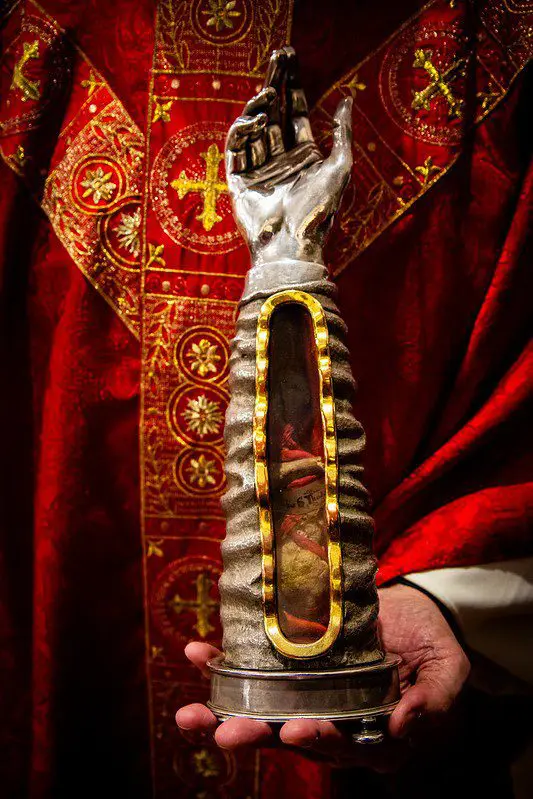
A special mission at a Derby parish will include veneration of a first-class relic of St. Jude Thaddeus, one of the Twelve Apostles of Jesus Christ. 

The relic, an arm bone of St. Jude’s right hand, can be venerated during the “St. Jude Mission, Mass and Veneration” from March 10 to 12 at St. Mary the Immaculate Conception Church, part of Our Lady, Queen of the Apostles Parish. 

Born around the year 5 A.D., St. Jude is venerated as the patron saint of lost causes and desperate situations. His intercessions have inspired devotions for centuries. If people pray to St. Jude in times of distress, it is said he will intercede and help them find the strength to continue. 

The mission will mark the beginning of Lent and celebrate the Jubilee Year of Hope 2025 designated by Pope Francis. The event will also honor the patron saint of the former St. Jude Church, now part of Our Lady, Queen of the Apostles Parish. 

“I feel like the Holy Spirit brought this together for us in the Jubilee Year and for people to come together and deepen their friendship with Christ and with the Holy Spirit, who is the well-spring of hope and is fueled by the work of the apostles, like St. Jude,” says Father Jeffrey Gubbiotti, pastor.

The St. Jude mission will be conducted by Father Michail P. Ford, O.P., director of the Dominican Shrine of St. Jude Thaddeus in Chicago. He travels throughout the United States, teaching on a myriad of topics including Catholic devotions.

As the universal Church embraces the Jubilee Year of Hope, the Shrine of St. Jude continues to serve as a powerful symbol of faith and perseverance. “It reminds the faithful that even in the most desperate situations, hope prevails,” Father Ford says. “St. Jude is the apostle of seemingly impossible situations.”

After his martyrdom, St. Jude’s body was buried in Iraq, formerly known as Mesopotamia. It was later moved to St. Peter’s Basilica in Rome where it rests with other apostles. 

Centuries ago, a small relic from St. Jude’s forearm was encased into a silver reliquary and preserved for many years in three different locations: Armenia, Turkey and Turin, Italy. In 1949, the Dominicans in Turin presented the relic to the Dominican Shrine of St. Jude on its 20th anniversary dedication. 

Mission preaching, oil blessings, confessions, a prayer service with music and veneration of the relic will begin at 7 p.m. on March 10 and 11 at St. Mary the Immaculate Conception Church, 212 Elizabeth St., Derby. The mission will conclude with a St. Jude Mass and veneration at 7 p.m. on March 12, at the Church. Father Ford will also speak at all Masses in the parish during the weekend of March 8 and 9. 

For more information about the St. Jude mission, visit Our Lady, Queen of the Angels Parish at olqaderby.org or call 203.735.3341. All are welcome to attend. 

“The true impact of these missions lies in the powerful faith-filled stories we hear,” Father Ford says. “At a recent mission, a young woman tearfully shared how her faith in St. Jude’s intercession never wavered when her husband was on the brink of death. Now, though not yet fully recovered, he stood beside her, a living testament to faith and hope.”

Prayer request can be placed on the Dominican Shrine of St. Jude website, the-shrine.org, or by calling the prayer line, 385.330.9005. A friar at the shrine regularly listens to these requests and prays for the requestor’s intentions.

CREDIT: SUBMITTED BY DOMINICAN SHRINE OF ST. JUDE A relic, an arm bone of St. Jude’s right hand, can be venerated during a special mission from March 10 to 12 at Our Lady, Queen of the Apostles Parish in Derby.